Telehealth Kit Buyer's Guide 2026: Hardware, Software, Compliance and Pricing
Shopping for a telehealth kit in 2026 is a lot like shopping for a car from dealership brochures: every vendor claims theirs is the best, nobody publishes a real price, and no salesperson shows you what's under the hood. We spent several weeks going through the product pages of the main manufacturers in Europe and North America, comparing what actually ships in the box, and cross-checking that against the real needs of home-visit nurses, primary care groups, long-term care facilities, rural clinics and community pharmacies. This guide is the result of that work — a vendor-neutral reference document to help you avoid expensive mistakes when investing thousands of dollars in medical equipment.
By the end of this page, you will know: what a telehealth kit really is, which instruments it should contain (and which are absent from entry-level configurations), how much it costs depending on the configuration, what compliance requirements apply to patient health data in the US, EU and internationally, how to think about reimbursement, and which criteria actually matter when you're choosing a vendor that will still be around in five years.
1. What is a telehealth kit?
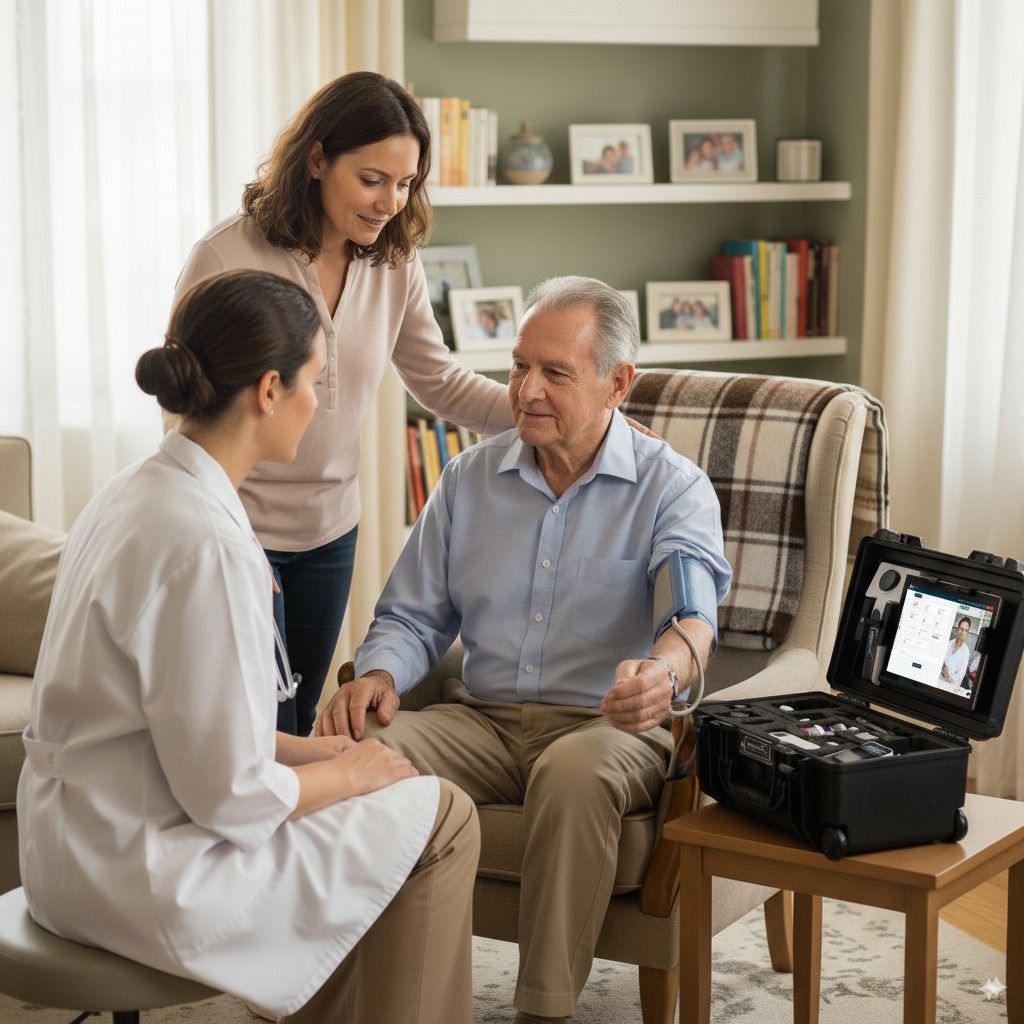
A telehealth kit — also called a mobile teleconsultation case, a portable telemedicine station, or simply a telemedicine cart's mobile cousin — is a portable unit bringing together three inseparable components: a computer or tablet, a set of connected medical instruments (ECG, stethoscope, vital signs monitor, medical camera, etc.), and telemedicine software allowing a remote physician to see, hear and measure the patient in real time.
What distinguishes a kit from a simple bag containing a few connected devices is the consistency of the system: every instrument must communicate with the software in real time during the consultation, with no manual re-entry. If you need to open four different applications to view an ECG, listen to a heart murmur and send a prescription, you don't have a kit — you have a stack of tools held together with duct tape.
Globally, the telehealth kit category has grown sharply since 2020. The World Health Organization's Global Strategy on Digital Health 2020-2025 pushed member states to expand remote clinical services, and the American Telemedicine Association (ATA) has published multiple playbooks on mobile telehealth for rural and underserved populations. The market is still fragmented: dozens of vendors, widely inconsistent feature sets, and virtually no public pricing. This guide tries to cut through that noise.
2. Kit vs cart vs backpack vs booth: the practical difference
Before investing, understand that the telehealth hardware market offers several form factors that do not serve the same use cases. Confusing them is one of the most expensive mistakes we see.
- The telehealth kit is built for daily mobility: home-visit nurse rounds, community health worker programs, mobile screening clinics, long-term care facility in-room exams. Typical weight: 13 to 22 lb (6–10 kg). It sets up on a bedside table in under 5 minutes.
- The telehealth cart is a wheeled fixed station, ideal for specialist clinics, hospitals and multi-bed care facilities. Larger, it accommodates a bigger screen and can carry bulkier instruments such as a portable ultrasound probe.
- The telemedicine backpack is a lightweight version of the kit, built for environments where a wheeled case is impractical: mountain rescue, field deployments, remote community outreach. Narrower instrument range, but true ruggedisation.
- The teleconsultation booth or kiosk is a fixed installation, typically deployed in pharmacies, corporate campuses or retail health locations. The patient enters alone and consults a remote physician. Very different category — this is local infrastructure, not a mobile kit.
3. Who is a telehealth kit for? Four buyer profiles
There is no one-size-fits-all kit. A solution suited to a home-visit nurse running 10 patients a day is not the same as one designed for a primary care group covering a rural county, or a long-term care facility with 80 residents, or a community pharmacy offering walk-in telehealth. Each use case imposes its own priorities.
3.1 The home-visit or community health nurse
The home-visit nurse is often the first clinician to enter the patient's home. She runs 8 to 12 visits a day, alone, with tight time slots. Her kit must therefore be light, quick to deploy and simple to use. What matters for her:
- Under 18 lb (8 kg), fitting in the trunk of a compact car
- Deployment in under 5 minutes at the patient's home (case opened → tablet on → first instrument connected)
- Instruments that withstand intensive use — dozens of deployments per week
- A simple software interface that doesn't require juggling four different tools
- Clear billing workflows for the local reimbursement system (CPT/HCPCS codes in the US, national health-insurance schedules in the EU)
For the nurse profile, see also our dedicated solution for community and home-visit nurses.
3.2 The primary care group / rural clinic network
A multi-site primary care group or a rural clinic network faces a different problem than the individual clinician. The challenge is not the individual device — it's territorial coverage: equipping several providers, tracking activity centrally, enabling peer-to-peer specialist consults across the network.
For a primary care network, the kit becomes infrastructure equipment. The network coordinator needs to know how many encounters happen weekly, by whom, for which patients. They need a centralised dashboard, not a standalone device. And they need the hardware to fit within the budgets earmarked for rural health coordination, whether through Health Resources and Services Administration (HRSA) grants in the US, NHS Digital transformation funds in the UK, or Ministry of Health programs internationally. See our primary care network solution for deployment details.
3.3 The long-term care facility / nursing home
A long-term care facility doesn't deploy a kit for mobility. It uses it for one reason that alone justifies the investment: reducing avoidable emergency-department transfers. Every emergency transfer of an elderly resident costs the healthcare system several thousand dollars, mobilises an ambulance team, and is deeply disruptive for the patient — often triggering functional decline that never fully reverses.
With a kit, the on-duty nurse can perform a complete clinical examination in the resident's room (ECG, auscultation, vital signs, temperature), transmit the data to a remote on-call physician or geriatrician, and jointly make a decision based on real clinical data — not a phone description. In a significant share of cases, this avoids the transfer entirely. Multiple US pilots have shown reductions of 20-40% in avoidable hospitalisations when a nurse-assisted telehealth kit is deployed in skilled nursing facilities.
Key criteria for long-term care are compatibility with the facility's existing electronic health record (MatrixCare, PointClickCare, etc.), hardware robustness for 24/7 use, and reliable technical support during nights and weekends.
3.4 The community pharmacy and retail clinic
Pharmacies and retail clinics are a specific case: the kit is not mobile but installed in a dedicated exam corner or separate consultation room. It is used for walk-in teleconsultations or screening visits with a remote physician, often as part of expanded pharmacy-practice initiatives (minor-ailment consultations, hypertension screening, travel medicine). Constraints: handling several patients in sequence, automating payment and billing, and protecting confidentiality in a partly public environment.
4. Instruments: what a kit should — or should not — contain
This is THE section where vendors rarely separate marketing from clinical reality. Browse ten manufacturer websites and you'll see the number of "included" instruments swing from 3 to 12 with no consistent rationale. Here's what you actually need to know.
4.1 Essential instruments (regardless of use case)
- Vital signs monitor — blood pressure, pulse, oxygen saturation (SpO₂), temperature. This is the foundation. No serious kit ships without one.
- Connected digital stethoscope — for live cardiac and pulmonary auscultation transmitted to the remote physician. Prefer models with digital filtering (Eko CORE/CORE 500, Riester Ri-Sonic, Mintti SMARTHO) that enable recording for AI analysis. The Eko/Mayo Clinic partnership has published multiple studies on AI cardiac-anomaly detection from stethoscope recordings — a concrete example of how this modality is evolving.
- Multi-lens medical camera — a single device with interchangeable lenses (general-practice, dermatoscope, otoscope) covers three clinical functions with minimal bulk.
- Insurance / identification card reader — in markets with electronic health-card infrastructure (France, Germany, Taiwan, Estonia, several other EU countries), the kit must read the local identification card to log the encounter. In markets without this infrastructure (US, UK), automatic patient look-up from the EHR covers the same workflow.
4.2 Instruments that not everyone offers (and that make the difference)
- 12-lead Bluetooth ECG — a 12-lead ECG transmits a full cardiac trace in real time, clinically exploitable to detect arrhythmia, an ongoing infarction, ventricular hypertrophy. Beware: several entry-level kits ship a 1- to 3-lead ECG — this is not equivalent. A 1-lead ECG gives heart rhythm, not a cardiology diagnosis. If you have a patient with chest pain, you want 12-lead. Reference brands in 2026 are Cardioline (touchECG), Schiller (FT1, AT2+) and Edan (SE-1515). For clinical use, see our article on ECG teleconsultation and real-time data capture.
- Multi-parameter bio-analyzer — glucose, cholesterol, lactate, triglycerides, uric acid. Enables an immediate bedside biological panel without a laboratory. Valuable for diabetes management, cardiovascular risk follow-up, and remote monitoring of chronic disease patients.
- Portable spirometer — for respiratory function testing (FEV1, FVC, FEV1/FVC ratio). Essential if you follow COPD or asthma patients, and increasingly used in post-COVID long-term follow-up.
- Bladder scanner — non-invasive urinary retention measurement. Particularly useful in long-term care to avoid unnecessary catheterisation.
- Dental intraoral camera — for dental teleconsultation, still niche but growing fast in underserved areas where access to a dentist is limited.
- Ultra-portable ultrasound — typically offered as a complement for specialist use (point-of-care ultrasound, obstetric screening, cardiac echo, emergency triage). See our article on the ultra-portable ultrasound in telemedicine.
4.3 "Gadget" instruments (to evaluate cautiously)
Some commercial kits advertise instruments that sound impressive but are rarely used in routine clinical practice: pedometers, consumer connected scales, duplicate blood-pressure cuffs, consumer-grade infrared thermometers. If a manufacturer inflates its "instrument count" with this kind of item, take it as a warning signal.
For a broader view of equipment categories and the clinical cases they cover, see also our article Telemedicine Equipment: The Different Types Explained.
5. Software: the component everyone underestimates
This is the least glamorous section of the comparison — and yet it's usually where deployments succeed or fail. A kit is not just an assembly of instruments. It's a system. And software is what makes it a system.
The questions to ask any manufacturer are simple but revealing:
- Is the software included in the price, or billed separately? Some manufacturers sell relatively affordable hardware then charge a monthly software license that doubles or triples the total annual cost.
- Is it proprietary software or mere compatibility with third-party platforms? A kit "compatible with Zoom for Healthcare" is not a kit with integrated software. You'll still need to pay for, configure and maintain the external tool separately.
- Does the software actually support real-time instrument integration? Or does it ask you to export an ECG file and re-import it manually into the video-call interface?
- Is there a built-in patient record, electronic prescription, and billing workflow? Otherwise you're adding three more tools to your workflow — and three more login prompts for your clinicians.
- Does the software include an AI medical scribe that automatically generates a SOAP note at the end of each consultation? This feature, still rare in 2026, saves 10 to 15 minutes per encounter and cuts documentation burnout. For how AI scribes work in practice, see our article on AI-generated SOAP notes in telehealth.
- Do you have access to an integrated specialist-referral network — how many specialists, which specialties, what response time?
- EHR interoperability — does the software export structured data (HL7 FHIR, CCD, CCDA) to your EHR of record? In 2026, anything that can't speak FHIR is a liability.
6. Compliance: HIPAA, ISO 27001, GDPR, and the host-country rules
Health data regulation varies by country, but a few standards have become the de-facto global baseline for any serious telehealth vendor:
- HIPAA (United States) — the Health Insurance Portability and Accountability Act governs protected health information (PHI) in the US. Any vendor operating in the US must sign a Business Associate Agreement (BAA) and demonstrate a compliant security program. "HIPAA-ready" is marketing language — ask specifically whether the vendor will sign a BAA.
- ISO/IEC 27001:2022 — the international information-security management standard. Rare among small hardware manufacturers, it's a mark of operational seriousness. Ask for the certificate, the certifying body, and the date of the last external audit.
- SOC 2 Type II — widely used in US B2B procurement. An annual third-party audit of the vendor's security, availability, and confidentiality controls. If your procurement team asks for SOC 2 and the vendor doesn't have one, that's a signal.
- GDPR (European Union) — mandatory across the EU since 2018 for any processing of personal data, including health data. Verify that the vendor has appointed a Data Protection Officer and publishes a compliant privacy policy.
- HDS (France) / C5 (Germany) / Medicare Conditions of Participation (US) / N3 (UK) / IRAP (Australia) — several countries impose their own hosting or accreditation framework. Check what applies in your deployment country and verify the vendor actually meets it (don't settle for "we're compliant" — ask for the document).
- CE marking (EU) / FDA clearance (US) for medical devices — every connected instrument (ECG, stethoscope, analyzer) must carry a medical-grade regulatory clearance, not a consumer-electronics mark. A "CE-marked Bluetooth device" is not the same as a "CE-marked Class IIa medical device".
- Data residency — where is the data physically stored? Some public-sector buyers, and most national health ministries, require data residency in-country or at least in-region. Ask for the name of the cloud host (AWS, Azure, GCP, regional provider) and the datacenter region.
The minimum bar in 2026 for any kit targeting regulated healthcare buyers is ISO 27001 + either HIPAA or GDPR + named cloud host + data residency commitment. If a vendor can't clearly answer all four points, they are not ready for enterprise deployment.
7. How much does a telehealth kit cost in 2026?
This is the section where most articles stop. We'll write it anyway — because it's the most frequently asked and least published information in the market.
First truth: no major telehealth kit manufacturer publicly lists its prices in 2026. None. You have to request a quote, often sign an NDA, and sometimes attend a demo to get a number. This isn't accidental — it's a pricing strategy that lets vendors adjust the tariff per customer (hospital system, Ministry of Health, independent practitioner).
Second truth: the price depends heavily on configuration and business model (outright purchase vs monthly subscription) and varies significantly by region. Here are the ranges we observed in 2026, based on real quotes, vendor conversations and customer disclosures. Figures are in USD / EUR equivalents, ex-VAT or ex-sales tax.
Price ranges observed globally (ex-tax, 2026)
- Entry-level kit (3 to 5 instruments, no 12-lead ECG, no proprietary software): from ~$2,700 USD / €2,500 ex-tax for outright purchase, or ~$55 to $110 / €50 to €100 per month subscription. Often shipped "bare" — software integration is up to you.
- Integrated professional kit (core instruments + 12-lead ECG + digital stethoscope + bundled teleconsultation software + compliant hosting): between ~$5,500 and $16,000 USD / €5,000 to €15,000 ex-tax for outright purchase, depending on configuration. As subscription, count ~$165 to $440 / €150 to €400 per month all-inclusive. This is where the Promotal MedConnect kit sits: base configuration from approximately $3,200 USD / €3,000 ex-tax, full configurations above.
- High-end kit / complete mobile station (10+ instruments including ultrasound, spirometer, bio-analyzer, bladder scanner + integrated clinical software + AI scribe + specialist referral network): $16,000 to $33,000 USD / €15,000 to €30,000 ex-tax for outright purchase, or $440 to $880 / €400 to €800 per month subscription. This is the level of complete rural-clinic deployments and multi-site nursing-home programs.
- Premium emergency / SAMU / military station: above $33,000 USD / €30,000 ex-tax. Separate category, generally sold with premium software subscription and maintenance, used in emergency medical services, maritime, aeronautic or military contexts. Prices are not published and vary significantly with scope.
Third truth: in many countries, deployments are eligible for public or grant funding. In the US, HRSA rural health grants, Medicare telehealth expansion, and state-level Medicaid waivers can cover part or all of a rural clinic deployment. In the EU, national e-health transformation funds and European Regional Development Fund (ERDF) envelopes regularly support primary care telehealth. In the UK, NHS England's Innovation Agency Network routes grants to tech adoption in primary care. Ministries of Health in emerging markets frequently fund mobile telehealth as part of universal health coverage programs. Your first question, whatever your market, should be: "what public funding is available for this deployment?"
8. Reimbursement: can the kit pay for itself?
A telehealth kit is not a cost centre if it generates billable encounters. Reimbursement rules vary significantly by country, but the key question is the same everywhere: does your payer recognize nurse-assisted or patient-present teleconsultation as a billable act?
- United States: Medicare has permanently covered certain telehealth services since 2023, with specific CPT codes for synchronous audio-video visits (99421-99423 for e-visits, 99441-99443 for telephone visits, 99202-99215 for standard office visits delivered via telehealth). Many states expanded Medicaid telehealth coverage during the public-health emergency and extended it into permanent policy. Check with your state Medicaid agency and the ATA State Policy Resource Center for the latest rules.
- European Union: each member state has its own reimbursement schedule. France, Germany, Estonia, Denmark and the UK have relatively mature telehealth reimbursement frameworks. Other countries are still in transition.
- International: in emerging markets, reimbursement is often absent, but deployments are typically funded directly by the Ministry of Health or by international donors (Global Fund, World Bank, bilateral agencies).
The practical rule: before you buy a kit, ask your reimbursement team (or your billing consultant) three questions. (1) What billing codes apply to a nurse-assisted teleconsultation in my jurisdiction? (2) Does my EHR / practice management system support those codes? (3) What documentation does the payer require to approve the claim? If you can't answer all three, you're not ready to scale.
9. How to choose: the 12-criterion checklist
If you take one thing from this guide, make it this checklist. Before signing any quote, compare each supplier against these 12 points:
- 12-lead ECG — not 1 or 3 leads, 12. Verify the brand and model (Cardioline touchECG, Schiller FT1, Edan SE-1515, etc.).
- Digital stethoscope with cardiac/pulmonary filtering and an AI analysis option. Ask for the exact model and the AI partner.
- Multi-lens medical camera (general practice + dermatoscope + otoscope), rather than three separate devices.
- Included proprietary teleconsultation software, not just compatibility with Zoom or Doxy.me.
- Integrated patient record, electronic prescription and billing workflow, with HL7 FHIR export to your EHR.
- AI medical scribe that automatically generates a SOAP note at consultation end.
- Access to a specialist referral network — how many specialists, which specialties, what response time.
- Named cloud host and data residency — AWS, Azure, GCP, or regional provider. Don't accept "secure datacenter".
- ISO 27001:2022 certification plus the local regulatory framework (HIPAA BAA for US, GDPR for EU, HDS for France, etc.).
- SOC 2 Type II if you're in US B2B procurement.
- Local support — prefer a vendor with a hotline in your timezone and language, with a guaranteed response time (SLA).
- Transparency on total cost of ownership — hardware + software + maintenance + upgrades over 3 years. Demand a detailed quote, not a teaser price.
If a vendor fails on more than 4 of these 12, you're not looking at a professional solution — you're looking at packaging.
10. 2025-2026 trends: what's shifting in the market
The global telehealth kit market is tilting, slowly but steadily, toward more integrated and more software-driven solutions. Three structural trends are worth watching for 2025-2026:
10.1 Regulatory maturation of hybrid telehealth
In the US, the post-public-health-emergency rules for Medicare telehealth have stabilised, making permanent many of the flexibilities introduced during COVID. In the EU, the European Health Data Space (EHDS) regulation entered force in 2025 and will force vendors to expose structured export interfaces for patient data by 2027. In the UK, NHS Digital has been consolidating telehealth procurement into a smaller set of validated frameworks. All three trends favour vendors with real interoperability and compliance investment — and disadvantage small manufacturers who were surfing the post-COVID wave without a durable software backbone.
10.2 Clinical AI integration becomes table stakes
AI medical scribes (automatic SOAP note generation), automated cardiac-anomaly detection from stethoscope recordings, and algorithmic ECG interpretation (Glasgow algorithm embedded in Cardioline and Schiller devices) were marginal two years ago. They are now production-ready at several manufacturers. Any kit bought in 2026 without a clear AI roadmap risks obsolescence by 2028. For how an AI scribe works in practice, see our article on AI medical scribes in multilingual telehealth.
10.3 Consolidation of the vendor landscape
Several telehealth kit startups founded between 2018 and 2022 have quietly pivoted, merged or exited the market in 2024-2025. The surviving vendors are those that invested in both a durable software backbone and in healthcare regulatory certifications. For buyers, this simplifies the comparison — and makes the choice of a durable manufacturer with local support and serious certification more important than ever.
11. Frequently asked questions
Is a telehealth kit reimbursable?
The hardware itself is typically not "reimbursed" per se. However, the clinical encounters performed with it (teleconsultations, nurse-assisted visits, specialist consults) are billable to the local payer under the current telehealth nomenclature. In many markets, public-sector deployments are eligible for direct grant funding (HRSA in the US, national e-health funds in the EU, Ministry of Health programs internationally). Start by asking your local reimbursement authority what coverage applies.
Can a kit be used without a stable internet connection?
Yes, provided you choose a solution that offers an asynchronous or store-and-forward mode: clinical data (ECG, vitals, images) is captured offline, then transmitted to the physician as soon as connectivity returns. This mode is particularly valuable in rural areas, remote territories, and humanitarian deployments. Verify explicitly with the vendor that this mode is available and tested in real field conditions — not just on a slide deck.
How much does a telehealth kit weigh?
A professional mobile kit weighs 13 to 22 lb (6 to 10 kg). Under 13 lb you probably have a "teleconsultation bag" rather than a real clinical kit — useful for very specific field uses but limited in instrument range. Over 22 lb you lose daily mobility, which becomes a blocker for home-visit nurse rounds.
Which kit should a primary care group choose?
For a primary care group or rural clinic network, the key criterion is not weight or unit price but the ability to equip several providers coherently and track activity centrally. Prefer: proprietary software with a network-wide dashboard, compatibility with your EHR of record, and a vendor capable of shipping multiple kits synchronised with a single training program for the whole team.
How long does it take to deploy a kit?
Two deployments to distinguish: daily bedside deployment (open the kit, turn on the tablet, connect instruments) should take under 5 minutes. Initial organisational deployment (hardware configuration, platform setup, user accounts, training, EHR integration, security review) takes 2 to 6 weeks for an integrated professional solution. Beware "48-hour deployment" promises — they usually hide superficial software, rushed training, or a skipped security review.
Is the kit compatible with my current EHR?
Crucial question, and the answer depends entirely on the vendor. Ask before the quote. In the US, common integrations target Epic, Cerner/Oracle Health, Athenahealth, eClinicalWorks, NextGen, and Meditech. In long-term care, ask about MatrixCare and PointClickCare. In the EU, country-specific EHRs dominate. Ask for a live demo of the integration — not just a checkbox on a brochure.
Does a telehealth kit replace video-consultation software like Zoom for Healthcare or Doxy.me?
No, they address different needs. Zoom for Healthcare, Doxy.me, Teladoc Health and similar platforms are video-consultation and scheduling tools. A kit adds what they lack: remote clinical examination with connected medical instruments. You can continue using your existing video-consult platform for scheduling if that's already in place — but kit-assisted encounters deliver a complete clinical act that plain video-consult cannot.
Where are telehealth kits manufactured?
Not all "locally-made" telehealth kits are actually assembled in-country. Some are imported from Asia and simply rebranded. Others are genuinely designed, assembled and configured in-country — which matters for support responsiveness, spare-parts availability, and regulatory liability. Explicitly ask where the kit is assembled, where the after-sales service is located, and in which country technical support is based. A vendor that is proud of their manufacturing chain will tell you immediately.
What's the best time of year to buy a telehealth kit?
Healthcare budgets typically open at the start of the fiscal year (January or April depending on the country) and close in the final quarter. Vendors are more willing to negotiate outside of those peaks. For public-sector deployments, monitor grant calendars several months in advance — grants are rarely announced with enough lead time to buy reactively.
12. Key takeaways
A telehealth kit in 2026 is not a stack of devices in a ruggedised box. It's an integrated clinical system: certified medical hardware, proprietary software, compliant hosting, staff training, multi-year maintenance, and EHR interoperability. The three most costly mistakes we see on the ground are (1) choosing a kit without a 12-lead ECG thinking "1-lead will do", (2) underestimating software cost by stacking third-party tools, and (3) skipping compliance due diligence until a procurement reviewer asks for documentation.
Conversely, successful deployments share three traits: a vendor with genuinely integrated proprietary software, verifiable regulatory certifications (ISO 27001 + local framework + named cloud host), and in-country support with a named contact. Price matters, of course, but it's rarely the decisive factor — support quality, vendor durability and software roadmap (clinical AI, interoperability, feature evolution) weigh more heavily over five years.
If you want to see concretely what an integrated professional kit looks like against these criteria, our MedConnect telehealth kit product page details the full configuration, technical datasheet, included instruments and software platform. For a vendor-neutral comparison with other market players, see also our 2026 telehealth kit comparison.
And if you simply want the full catalog as a PDF before you decide, you can download the Promotal MedConnect catalog — no sales call involved.
Ready to discover MedConnect?
Request a personalized demo and see how the platform adapts to your practice.
Request a demo