Telemedicine Equipment: The Different Types Explained
Telemedicine is not just a video call. Behind an effective remote consultation lies a set of medical devices, hardware configurations, and software tools that allow the clinician to conduct a real examination — not just exchange words. Understanding the different types of equipment available is the first step towards building a genuinely operational remote care programme.
Communication devices: the foundation of every teleconsultation
Before any medical device, teleconsultation rests on a reliable communications infrastructure. This includes:
- A computer, tablet, or dedicated screen with HD camera
- A quality microphone and headset
- A stable internet connection (wired preferred for clinical data streams)
- A secure video conferencing solution, integrated or not into a health platform
These elements form the minimum baseline. They are sufficient for a simple teleconsultation, but do not allow a clinical examination to be conducted remotely. This is where connected medical devices come in.
Connected medical devices for remote clinical examination
This is the category that makes the real difference between a video call and a medical consultation. These devices transmit clinical data in real time to the remote physician.
Cardiovascular
Connected 12-lead ECG — The electrocardiogram remains one of the most requested examinations in teleconsultation. A connected portable ECG allows an on-site nurse to perform the examination, with the tracing immediately available to the remote cardiologist. With a platform like MedConnect, the 12-lead ECG PDF is automatically added to the patient record in approximately 5 seconds. To go further, read our article on the connected ECG in telemedicine and what the doctor sees remotely.
Digital stethoscope — Remote auscultation is now possible thanks to electronic stethoscopes. Cardiac or pulmonary sounds are captured locally and streamed in real time to the remote practitioner. Brands such as Welch Allyn and Riester offer CE-certified models compatible with telemedicine platforms. Discover how remote auscultation with a digital stethoscope works in practice.
Connected blood pressure monitor — Bluetooth or Wi-Fi blood pressure monitors enable chronic patient monitoring without travel, with automatic upload of readings to the patient record.
Respiration and oximetry
Connected pulse oximeter — Essential for monitoring respiratory or cardiac conditions, it measures SpO₂ and heart rate. Easy to use, it can be operated by the patient themselves.
Connected spirometer — For remote respiratory function assessments, particularly in COPD or asthma follow-up.
Exploration and imaging
Digital dermatoscope — Enables analysis of skin lesions with high-resolution images transmitted to the remote dermatologist. Particularly useful in rural areas or nursing homes.
Digital otoscope — Captures images of the ear canal and eardrum for remote ENT examination. Widely used in paediatrics and remote general medicine.
Ultra-portable ultrasound — The miniaturisation of ultrasound devices has opened the way for imaging in telemedicine. These pocket devices allow emergency or follow-up examinations in the field. To learn more, read our article on the ultra-portable ultrasound in telemedicine.
Metabolic and biological
Connected glucometer — Essential for diabetes management, it transmits blood glucose readings directly to the care team to adapt treatment in real time.
Portable biological analyser — Some advanced platforms integrate point-of-care analysers (CRP, troponin, basic blood count) whose results are automatically uploaded to the patient record.
Connected thermometer — Contactless temperature measurement with automatic data transmission, useful for rapid triage in nurse-led consultations.
Hardware configurations: cart, kit, or backpack
Medical devices are rarely used individually. They are grouped into configurations suited to the context of use. To choose the configuration best suited to your programme, the article telehealth kit or cart: how to choose covers the essential criteria.
The telemedicine cart
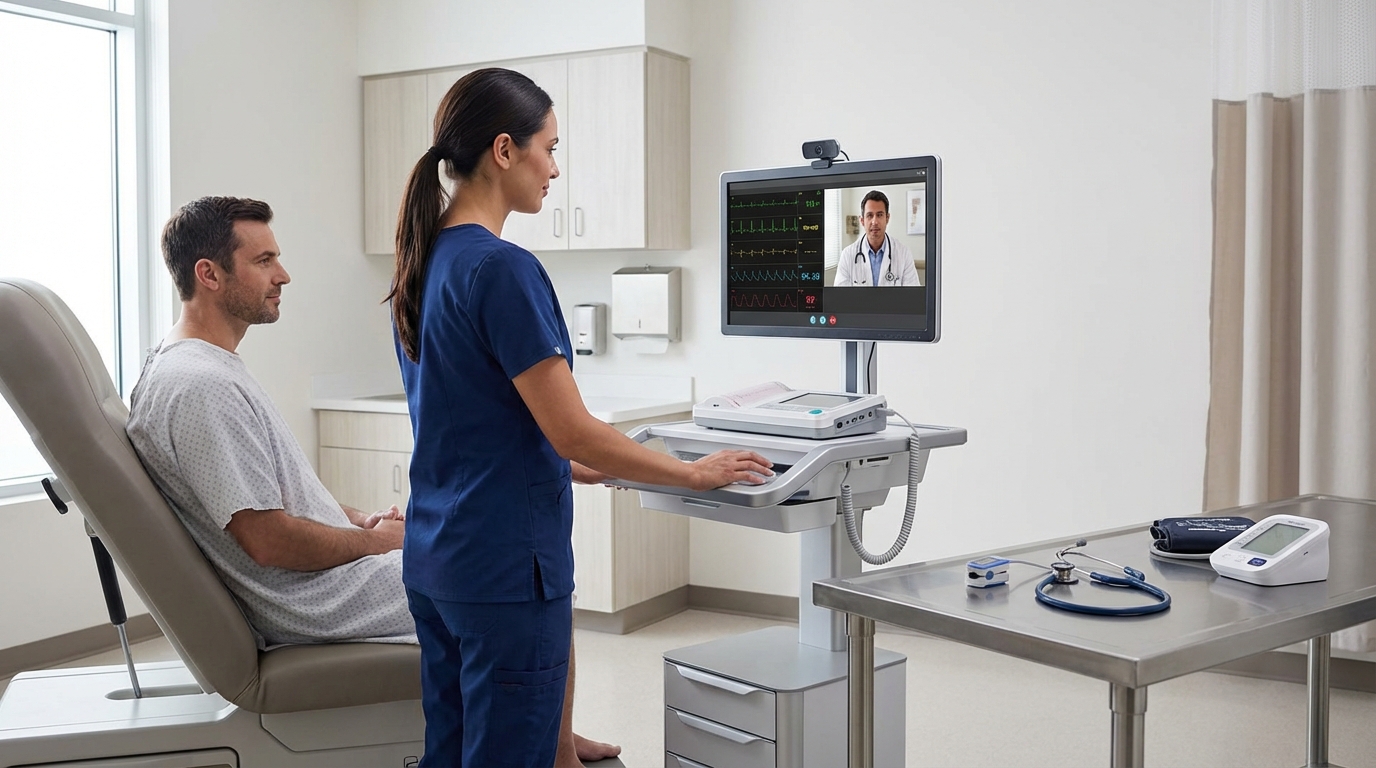
Designed for fixed or semi-fixed installations (hospital wards, nursing homes, health centres), the telemedicine cart incorporates an integrated screen, HD camera, and multiple medical devices in a mobile, ergonomic unit. It is the preferred solution for high consultation volumes in a structured environment.
The telemedicine kit
A portable format, designed for home visits or satellite practice deployments. It contains the essential diagnostic equipment in a compact case that fits in a car boot. Ideal for visiting nurses and rural physicians.
The telemedicine backpack
The lightest and most mobile solution, designed for field operations, isolated rural areas, or humanitarian programmes. It weighs under 3 kg with essential vital signs equipment and a stethoscope, connected to the same software platform.
The software platform: the link between hardware and clinician
No equipment delivers its full value without a software platform that centralises data. A complete solution must integrate:
- Appointment scheduling and consultation management
- Secure video teleconsultation
- The patient record with automatic ingestion of device measurements
- Billing and tele-expertise (specialist referral)
- An AI medical scribe for transcription and automatic SOAP note generation
MedConnect offers exactly this architecture in a single system, with no middleware or adapters for medical devices from Welch Allyn, MIR, Schiller, Riester, Cardioline, and EDAN Instruments. Organisations wishing to go further can consult the complete telemedicine platform deployment guide for nursing homes, primary care networks, and mobile deployments.
Choosing equipment according to the care context
There is no universal configuration. The right equipment depends on the context:
| Context | Recommended configuration | Priority devices |
|---|---|---|
| Nursing home / care facility | Fixed cart | ECG, stethoscope, oximeter, blood pressure monitor |
| Home visits | Portable kit | Stethoscope, blood pressure monitor, oximeter, thermometer |
| Rural / field setting | Backpack | Vital signs, stethoscope |
| Hospital / polyclinic | Multi-device cart | 12-lead ECG, ultrasound, dermatoscope, otoscope |
| National programme (e.g. Hajj) | On-premise + cart | ECG, biological analyser, vital signs |
The question is not just "which device to buy" but "which examination must the clinician be able to perform remotely". Starting from that angle, the choice of equipment becomes much clearer — and the consultations, clinically far more useful.
Ready to compare configurations? The full range of telemedicine equipment — carts, kits, connected diagnostics and software — is detailed with equipment lists and cost factors.
Ready to discover MedConnect?
Request a personalized demo and see how the platform adapts to your practice.
Request a demo