Telehealth Backpack for Mobile Clinics: Use Cases and Deployment Guide for 2026
A nurse arrives at a remote village carrying a backpack. Inside: a 12-lead ECG, a digital stethoscope, a dermatoscope, and a tablet. She connects to a cardiologist 400 kilometers away. The ECG uploads to the patient file in 5 seconds. The consultation documents itself. This is not a future scenario — it is happening now.
The telehealth backpack has become one of the most practical tools for extending clinical reach beyond fixed facilities. But the hardware is only half the equation, and not all backpacks are built the same. This guide covers what a telehealth backpack is, where it fits, what to look for in 2026, and how to deploy one without creating new operational problems.
What Is a Telehealth Backpack?
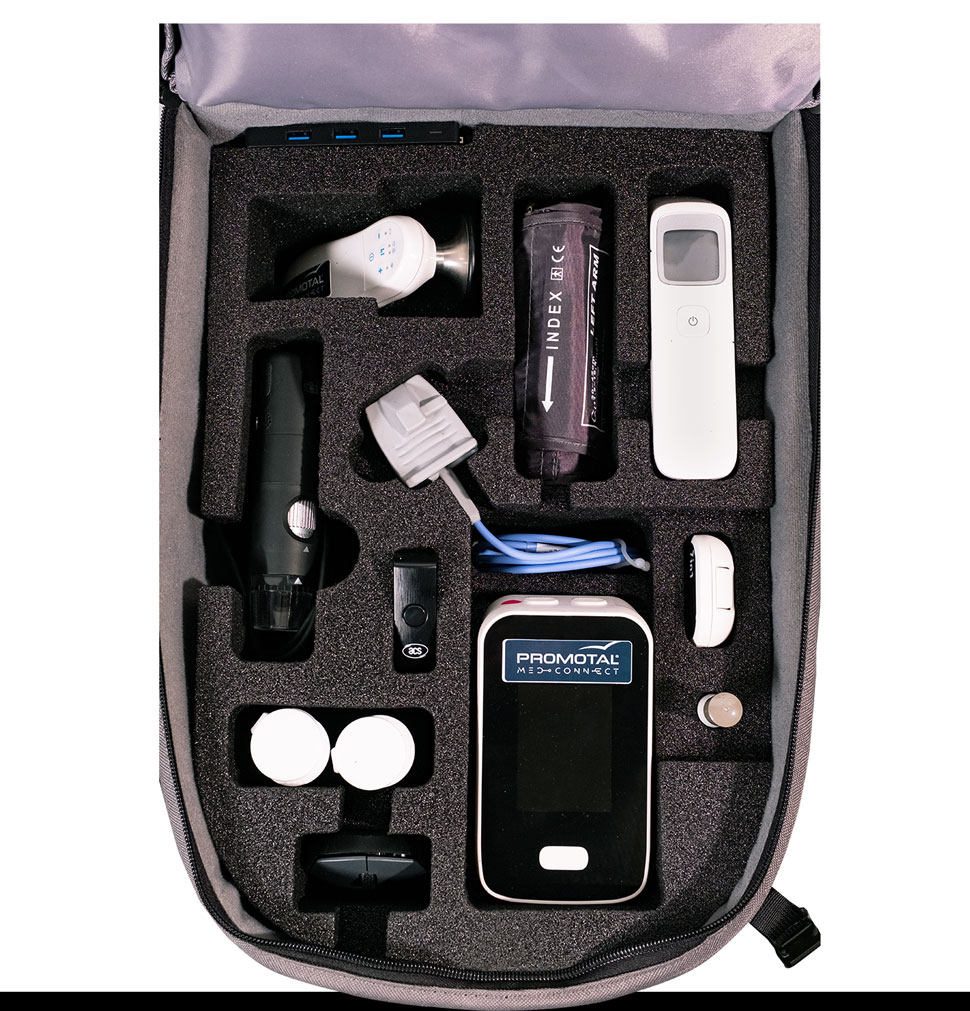
A telehealth backpack is a portable, self-contained clinical kit that allows a healthcare professional to conduct a full remote consultation from any location. It typically includes diagnostic devices — ECG, stethoscope, pulse oximeter, blood pressure cuff, otoscope — along with a connected tablet or laptop and the software to run a live video consultation with a remote clinician.
The key word is full. A video call is not a telehealth consultation. A proper telehealth backpack lets the nurse or generalist on-site capture objective clinical data and transmit it in real time to a specialist or supervising doctor. If that data has to be entered manually afterward, or sent as a photo attachment, the clinical value drops sharply.
Who Actually Needs One
Telehealth backpacks are not the right fit for every setting. They make the most sense when:
- Your care team moves between locations rather than working from a fixed room
- You serve patients who cannot travel to a clinic — elderly, mobility-limited, or rural populations
- You are deploying care somewhere without permanent infrastructure
- You need a backup configuration for when a fixed cart or consultation room is unavailable
The primary users are nurses conducting home visits or rounds across multiple facilities, mobile clinic teams, and field health workers in humanitarian or government programs. Secondary users include GPs covering multiple rural sites and NGO medical teams operating in low-resource environments.
Core Use Cases in 2026
Rural and Medical Desert Coverage
France has over 5 million people living in areas classified as medical deserts. The 2026–2028 government telehealth mandate is pushing regional health networks — GHT, ARS-funded programs, CPTS — to build remote consultation capacity quickly. A backpack configuration lets a single nurse cover multiple communes in a week without requiring each site to invest in a fixed consultation room.
The nurse handles the physical examination on-site. The remote GP or specialist handles diagnosis and prescribing. The patient receives a real consultation, not a phone call.
Nursing Home and Home Visit Programs
EHPAD directors face a familiar problem: residents need specialist input regularly, but transporting elderly patients is costly, disruptive, and often clinically risky. A telehealth backpack lets the on-site nurse conduct a cardiology or dermatology consultation directly in the resident's room.
For home visit programs, it gives visiting nurses the diagnostic tools to escalate appropriately — rather than defaulting to emergency services when the clinical picture is unclear.
Mobile Clinic and Field Deployment
Mobile clinics serving underserved urban populations, refugee settlements, or post-disaster zones need equipment that survives transport, sets up quickly, and functions without reliable fixed infrastructure. A backpack with offline capability and cloud sync when connectivity is restored fits this context well.
The clinical workflow still needs to be complete. That means device data going directly into patient records — not onto paper that gets transcribed later.
Humanitarian and Ministry Programs
Large-scale government and NGO deployments — vaccination campaigns, screening programs, disaster response — require equipment that can be issued to dozens of field teams at once. Backpacks are lighter and cheaper to ship than carts, and when configured identically across a fleet, every team runs the same clinical workflow.
MedConnect has direct experience in this environment: 15 systems were deployed for the Saudi Ministry of Health Hajj 2025 program, supporting high-volume clinical operations in a demanding field setting.
What Equipment Should a Telehealth Backpack Include?
The right device set depends on your clinical use case. For primary care and general medicine, here is a practical baseline:
| Device | Clinical Purpose |
|---|---|
| 12-lead ECG | Cardiac screening, arrhythmia detection |
| Digital stethoscope | Cardiac and pulmonary auscultation, streamed live |
| Pulse oximeter | SpO2 and heart rate |
| Blood pressure monitor | Hypertension management, triage |
| Otoscope | ENT examination |
| Dermatoscope | Skin lesion assessment |
| Thermometer | Infection screening |
| Tablet / laptop | Video consultation, platform interface |
For programs focused on respiratory or cardiac pathology, ECG and stethoscope are non-negotiable. For dermatology or ENT-heavy workflows, the dermatoscope and otoscope move up in priority.
All devices should be CE-certified for professional clinical use. Consumer-grade hardware is not appropriate for clinical documentation or billing.
The Difference Between a Backpack and a Telehealth Kit
The terms are sometimes used interchangeably, but they describe different configurations.
A telehealth kit — also called a medical kit or case — is typically a hard-shell case designed for transport and use in a semi-fixed setting: a satellite clinic consultation room, a school health office, a pharmacy. It prioritizes protection and completeness over portability.
A telehealth backpack puts mobility first. It is designed to be carried by one person across varied terrain, set up in under five minutes, and used in environments without dedicated clinical infrastructure. Weight and pack size matter. So does battery life.
Both configurations connect to the same platform. The clinical workflow — video, device data, patient record, billing — is identical regardless of which hardware form factor you use. You can compare MedConnect's telehealth backpack and telehealth kit to identify which fits your deployment context.
Deployment Considerations Before You Buy
Hardware is the straightforward part. The harder questions are operational.
Connectivity. Does your deployment area have reliable 4G or 5G? If not, you need a platform that handles intermittent connectivity without losing clinical data — buffering device output, syncing records when the connection is restored, and not dropping a consultation mid-ECG.
Data sovereignty. Deploying in France or the EU means patient data must stay in the EU. Working with a Middle Eastern ministry means local data center options matter. Confirm where your platform hosts data before you sign anything.
Staff training. A backpack with six devices is only useful if the nurse operating it knows how to use each one correctly. Training time is a real deployment cost. Platforms where the interface is consistent across devices and documentation is automated reduce the cognitive load on your clinical staff.
EMR integration. If your organization already uses an electronic medical record system, the backpack's platform needs to connect to it. Manual re-entry of device data defeats the purpose entirely.
Compliance. ISO 27001 and HIPAA certification are the baseline for any platform handling patient data at scale. GDPR compliance is mandatory for EU deployments. Confirm certifications before deployment — not after.
How the Platform Behind the Hardware Defines Clinical Value
A backpack full of devices and a tablet running a generic video call is not a telehealth solution. It is a bag of hardware.
The platform is what determines whether a telehealth backpack delivers real clinical value or just creates new documentation work. The questions that matter:
- Does device data go directly into the patient file, or does someone have to type it in?
- Does the remote doctor see the ECG and hear the stethoscope during the consultation, or do they receive a report afterward?
- Is the consultation automatically documented, or does the nurse write notes by hand?
- Can the on-site team refer to a specialist within the same workflow, or does that require a separate system?
MedConnect handles all of this from one screen. The 12-lead ECG uploads to the patient record in 5 seconds. The digital stethoscope streams live audio to the remote doctor. Elara, the AI clinical assistant, generates a SOAP note in real time — in French, English, Arabic, or Italian. Specialist referral happens within the same platform, without switching tools.
The backpack connects to the same full-stack platform as the cart and the kit. Choosing the portable hardware does not mean accepting a reduced version of the software. The clinical workflow is complete regardless of form factor.
For organizations managing multiple care sites — primary care networks, nursing home groups, regional health networks — that consistency matters. Your field teams and your fixed-facility teams run identical workflows. Training is simpler. Audit trails are consistent. Compliance is easier to maintain across the board.
You can review the full platform capabilities and all three hardware configurations at promotal-medconnect.com.
FAQs
What devices are typically included in a telehealth backpack? A clinical telehealth backpack for primary care typically includes a 12-lead ECG, digital stethoscope, pulse oximeter, blood pressure monitor, otoscope, and dermatoscope, along with a tablet or laptop for the video consultation interface. The exact configuration depends on the clinical use case and deployment conditions.
How long does it take to set up a telehealth backpack for a consultation? A well-designed backpack should be ready for a consultation in under five minutes. Setup time depends on device connectivity, platform login, and the clinician's familiarity with the equipment. Platforms that auto-connect devices and pre-load patient records reduce setup time significantly.
Can a telehealth backpack work in areas with poor internet connectivity? It depends on the platform. Some buffer device data locally and sync when connectivity is restored. Others require a continuous connection throughout. If you are deploying in rural or field environments, confirm the platform's offline behavior before you commit.
What is the difference between a telehealth backpack and a telehealth cart? A telehealth cart is designed for fixed or semi-fixed consultation rooms — more storage, a larger screen, easier device management in a stable environment. A backpack is optimized for mobility: lighter, more compact, carried by one person across varied settings. Both can connect to the same clinical platform.
Is a telehealth backpack compliant with EU data regulations? Compliance depends on the platform, not the hardware. For EU deployments, the platform must be GDPR-compliant and ISO 27001 certified, with patient data hosted in EU data centers. Confirm these certifications with your vendor before deployment.
How many devices can a telehealth backpack realistically support? Most clinical telehealth backpacks support between four and eight devices. The practical limit is weight and the clinician's ability to manage the equipment during a visit. Prioritize the devices most relevant to your clinical use case rather than maximizing device count.
What is the typical cost of a telehealth backpack solution? Costs vary based on device configuration, platform licensing, and deployment scale. Entry-level configurations start at a few thousand euros. Full clinical configurations with AI documentation, device integration, and enterprise compliance certification are priced to reflect the clinical completeness they deliver. Review MedConnect's pricing for current options.
Conclusion
A telehealth backpack is only as useful as the clinical workflow it enables. The hardware gets your team into the field. The platform determines whether what happens there constitutes a real consultation — or just a video call with a bag of devices attached.
If you are planning a mobile clinic deployment, expanding nursing home coverage, or responding to a ministry mandate in 2026, start with your workflow requirements and work backward to the hardware. Confirm data sovereignty, device integration, AI documentation, and compliance before you commit to anything.
To see how a full-stack backpack deployment works in practice, visit promotal-medconnect.com or request a demo directly.
Ready to discover MedConnect?
Request a personalized demo and see how the platform adapts to your practice.
Request a demo