Digital Stethoscope for Telehealth: How the Skeeper SM-300 Transforms Remote Auscultation in 2026
Why Remote Auscultation Has Always Been the Hard Part
Telehealth has come a long way on video quality, scheduling, and documentation. The stethoscope, though, has remained a stubborn problem.
A remote doctor can see a patient, review labs, read notes, and prescribe medication. What they cannot do — without the right hardware — is hear the patient's heart, lungs, or bowel sounds in real time. That gap has quietly undermined the clinical value of countless teleconsultations.
It is not a minor inconvenience. Auscultation is a core diagnostic step for cardiac, respiratory, and abdominal assessments. Skipping it, or pushing it to an in-person follow-up, defeats much of the point of a remote consultation in the first place.
The Skeeper SM-300 is a digital stethoscope built to close that gap. This article covers what it does, how it performs in clinical settings, and why the device only reaches its full potential inside a complete telehealth platform — not used in isolation.
What Is the Skeeper SM-300?
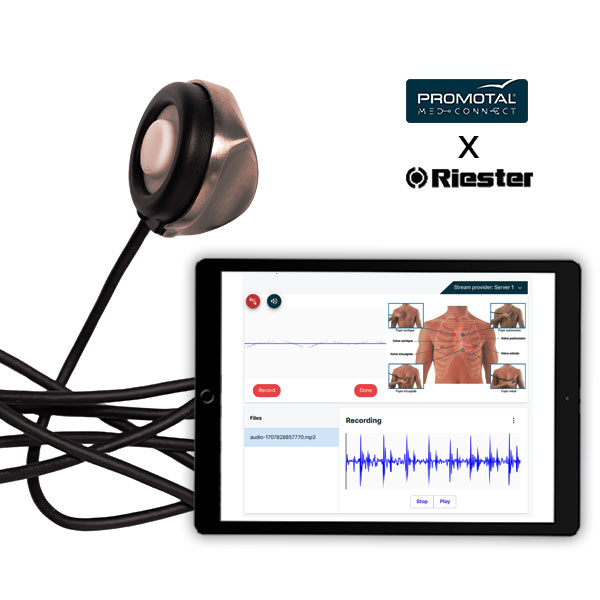
The Skeeper SM-300 is a professional-grade digital stethoscope designed for telehealth and remote clinical consultation. It captures cardiac, pulmonary, and abdominal sounds and transmits them in real time to a remote clinician over a secure connection.
Unlike a conventional acoustic stethoscope, the SM-300 converts analog sound into a digital audio signal that can be streamed live during a video consultation. The remote doctor hears what the on-site nurse or health worker is capturing at the patient's bedside — as it happens.
The device is CE-certified for professional clinical use and is built to operate within structured telehealth workflows, not as a standalone consumer product.
Key Features of the Skeeper SM-300 for Clinical Use
Sound Quality and Frequency Range
The SM-300 captures a wide frequency range covering both cardiac and pulmonary sounds. That matters clinically because heart murmurs, crackles, and wheezes each occupy different frequency bands. A stethoscope that compresses or filters that range too aggressively will miss findings.
Digital amplification also makes the device practical in noisy environments — nursing home common areas, mobile clinics, field settings — where ambient noise is simply part of the job.
Wireless Transmission and Latency
The SM-300 transmits audio wirelessly to the connected platform with latency kept low enough for real-time interpretation. That is a non-negotiable requirement for auscultation. If the audio arrives with any meaningful delay, the remote clinician cannot correlate what they hear with what they observe on video.
Ease of Use for Nurses and Allied Health Staff
In most telehealth deployments, the person holding the stethoscope is not the doctor. It is a nurse, a health aide, or a community health worker. The SM-300 is designed with that reality in mind.
Clear placement guidance, straightforward connectivity, and minimal setup time reduce the training burden on non-physician staff. At scale — across networks operating across multiple sites with varying levels of clinical expertise on the ground — that simplicity is not a nice-to-have. It is a requirement.
The Skeeper SM-300 in a Full Telehealth Workflow
What Happens When the Stethoscope Is Just One Tool Among Many
Here is a scenario that plays out across care networks every day. A nurse at a remote site uses a digital stethoscope to capture lung sounds. She switches to a separate application to share the audio file. The remote doctor opens a third tool to view the patient record. The ECG from earlier in the visit is sitting in a fourth system, not yet linked to the file.
By the time the consultation ends, the doctor has pieced together a clinical picture from four disconnected sources. Nothing was captured automatically. The nurse spent 20 minutes on data entry after the visit.
A better stethoscope does not fix that problem.
Integration with MedConnect: Live Audio Directly to the Remote Doctor
The Skeeper SM-300 is integrated into the Promotal MedConnect platform. The audio stream goes directly to the remote doctor's screen during the live consultation — no file transfers, no application switching, no manual upload.
The remote clinician hears the auscultation in real time while watching the video feed. At the same time, the platform is capturing ECG data, displaying vitals, and logging the consultation. Elara, the AI medical scribe, is generating a SOAP note. Everything happens on one screen.
That is a materially different clinical experience from a digital stethoscope plugged into a standalone video call.
MedConnect supports three hardware configurations — a telehealth medical kit, a telehealth cart, and a backpack for field mobility — and the Skeeper SM-300 is available across all three. The platform is identical regardless of configuration, so the clinical workflow does not change from site to site.
For clinical operations leaders managing multiple locations, that consistency matters. Your teams learn one process, not a different one at every site.
Who Should Consider the Skeeper SM-300?
The SM-300 is a clinical tool, not a consumer device. It is the right fit for:
Primary care networks running nurse-led teleconsultation sites where a remote doctor supervises multiple locations. The stethoscope allows the remote physician to conduct a real examination — not just a video interview.
Nursing homes and EHPADs where residents need regular cardiac and respiratory monitoring but specialist access is limited. A nurse conducts the physical assessment while the remote doctor listens and interprets findings in real time.
Mobile and rural clinics where the backpack configuration allows a single health worker to carry a full diagnostic kit into the field. The SM-300 is part of that kit.
International health programs deploying clinical services at scale — including ministry-level programs where standardized equipment across sites is a procurement and training requirement.
If you are evaluating the SM-300 as a standalone device for occasional use, it will perform well. But if the goal is a repeatable, auditable remote consultation workflow across multiple sites, the device delivers its full clinical value inside a platform that handles the rest of the process.
Skeeper SM-300 vs. Other Digital Stethoscopes in 2026
| Feature | Skeeper SM-300 | Eko CORE 500 | TytoCare Stethoscope |
|---|---|---|---|
| Real-time audio streaming | Yes | Yes | Yes |
| Platform integration | Full (MedConnect) | Eko Health platform only | TytoCare ecosystem only |
| Multi-device workflow | Yes (ECG, vitals, dermatoscope) | Cardiac-focused | Limited device range |
| CE certified | Yes | Yes | Yes |
| On-premise deployment option | Yes (via MedConnect) | No | No |
| AI SOAP note generation | Yes (via MedConnect/Elara) | No | No |
| Deployment timeline | 2-4 weeks | Varies | Varies |
The Eko CORE 500 is a strong cardiac stethoscope, but Eko Health's platform is built around cardiac workflows. If your clinical needs extend to pulmonary, abdominal, or multi-specialty assessments, the workflow coverage runs out quickly.
TytoCare bundles a stethoscope within its proprietary device ecosystem, but that ecosystem requires patient-side training and does not support on-premise deployment. For institutional deployments with data sovereignty requirements, that is a significant constraint.
The Skeeper SM-300's advantage is not that it is the only digital stethoscope available. It is that it sits inside a platform covering the full consultation — video, devices, records, billing, and specialist referral — without requiring your teams to manage separate tools for each function.
FAQs
What is the Skeeper SM-300 used for? The Skeeper SM-300 is a digital stethoscope used for remote auscultation during telehealth consultations. It captures cardiac, pulmonary, and abdominal sounds and transmits them in real time to a remote clinician, allowing the doctor to conduct a genuine physical examination without being present at the patient's location.
How does the Skeeper SM-300 connect to a telehealth platform? The SM-300 connects wirelessly to compatible telehealth software. When integrated with MedConnect, the audio stream appears live on the remote doctor's screen during the consultation — alongside video, ECG data, and vital signs — all within a single interface.
Is the Skeeper SM-300 suitable for nursing home use? Yes. The SM-300 is designed for use by nurses and allied health staff, not only physicians. Its straightforward operation makes it practical in nursing home settings where a nurse conducts the physical assessment while a remote doctor supervises and interprets findings in real time.
Can the Skeeper SM-300 be used in mobile or field settings? Yes. The device is available as part of the MedConnect backpack configuration, designed for maximum field mobility. That makes it suitable for mobile clinics, rural health visits, and international health programs operating in remote areas.
How does the Skeeper SM-300 compare to the Eko CORE 500? Both are professional digital stethoscopes with real-time streaming capability. The Eko CORE 500 is primarily designed for cardiac use within the Eko Health ecosystem. The Skeeper SM-300 integrates into MedConnect, which supports multi-specialty workflows including ECG, vitals, dermatoscopy, and AI documentation — making it better suited to general primary care and multi-site deployments.
Does using the Skeeper SM-300 with MedConnect require additional software licenses? The Skeeper SM-300 is part of the MedConnect hardware and software bundle. Pricing starts at €3,000+ and covers the platform, devices, and deployment support. Configuration options and pricing are available at promotal-medconnect.com/en/pricing.
Is MedConnect compliant with EU data protection requirements? Yes. MedConnect is ISO 27001:2022 certified and HIPAA-ready (US deployments are configured for HIPAA under a BAA). EU customer data is hosted in European data centers, and a full on-premise deployment option is available for organizations with data sovereignty requirements.
Conclusion
The Skeeper SM-300 solves a real clinical problem: it puts auscultation back into the remote consultation. That alone is a meaningful step forward for any care network trying to deliver genuine diagnostic quality at a distance.
But a stethoscope is one instrument. The clinical value it produces depends on what surrounds it. When the audio stream feeds directly into a platform that also handles ECG data, vital signs, AI documentation, billing, and specialist referral, the consultation becomes something a video call never could be.
If your organization is evaluating digital stethoscopes for a telehealth deployment, the right question is not just how the device performs on its own. It is how it fits into the clinical workflow your teams need to run every day, across every site.
Learn more about how MedConnect integrates the Skeeper SM-300 into a complete remote consultation workflow at promotal-medconnect.com.
Ready to discover MedConnect?
Request a personalized demo and see how the platform adapts to your practice.
Request a demo