Asynchronous Telehealth: How Store-and-Forward Care Actually Works
Asynchronous telehealth — also called store-and-forward — means clinical data is captured at one moment and interpreted by a physician at another. Nobody has to be available at the same time. It is the opposite of a live teleconsultation, and it is frequently the only workable modality where connectivity is poor or calendars do not align.
How it actually works
A health professional performs the examination with the patient present: ECG trace, recorded auscultation, vitals, dermatoscopic or otoscopic images. The data is timestamped and attached to the patient's record. A physician or specialist then reviews it, returns a written opinion, and that opinion lands back in the same record. No shared appointment is required at any point.
When asynchronous is the right choice
- Insufficient connectivity — video needs sustained bandwidth; sending a file later does not. In rural and remote settings this is decisive.
- Calendar mismatch — the specialist does not have to be free at the moment of examination.
- Specialist opinion on objective data — an ECG trace or a skin image reads perfectly well after the fact.
- Volume — a cardiologist can review a batch of traces in one sitting, which is more efficient than sequential consultations.
- Mobile rounds — a team examines several patients offline and syncs at the end of the day.
When it is not
Asynchronous care does not suit emergencies, cases where the physician must direct the examination live ("move the probe up", "ask the patient to cough"), or decisions that depend on dialogue with the patient. Those still need synchronous assisted teleconsultation.
What the platform has to support
- A genuine offline mode — full capture with no connection, then later sync with no loss and no re-keying.
- Timestamping and audit trail — who captured what, when, and who returned the opinion.
- Automatic attachment to the record, not delivery by email.
- Encryption at rest, since the data sits waiting to be read.
- A structured referral workflow rather than a chat thread.
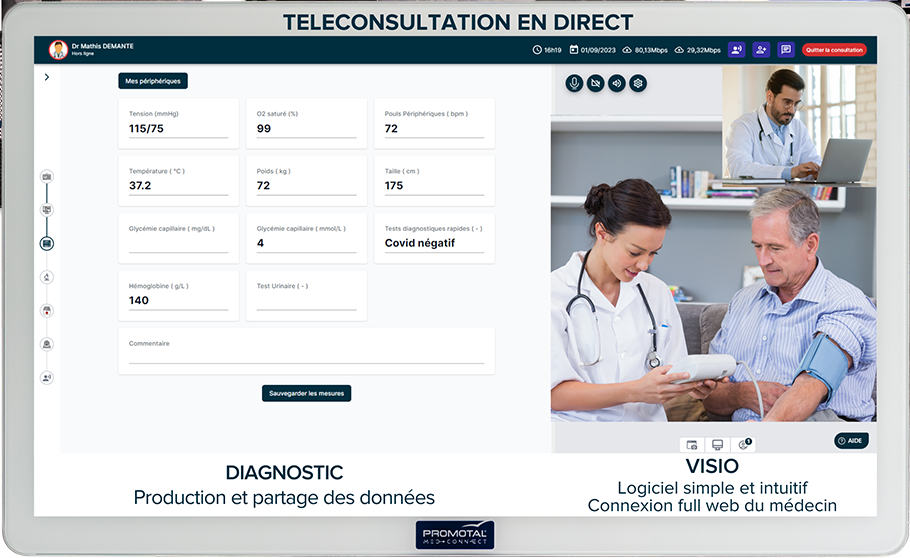
The MedConnect platform supports an asynchronous, offline mode for low-connectivity sites, with optional 4G or 5G connectivity, and files it into the same patient record as live consultations. See the platform and the telehealth kit that feeds it.
Frequently asked questions
Is asynchronous telehealth the same as tele-expertise? Tele-expertise is a specific act: one health professional requests a colleague's opinion, with no patient on the call. It is almost always asynchronous. Asynchronous is the technical modality; tele-expertise is one of the acts that uses it.
Is asynchronous care reimbursed? It depends on the jurisdiction and the act. In France, tele-expertise and télésoin carry their own billing codes, separate from teleconsultation. Amounts and conditions change, so confirm the current schedule with the payer before building a business case.
Is a connection needed to capture the data? Not if the platform has a real offline mode. This is the thing to test in a demo: ask to complete a full examination with the connection cut, then sync it.
Is asynchronous data less secure? It has a different risk profile: it sits at rest for longer, so encryption at rest and access management matter more than latency does.
Can asynchronous replace live teleconsultation entirely? No. It covers a different set of clinical situations. Most programmes run both and route by case — which is why the two should share one platform and one patient record rather than two systems.
Oral health is a concrete store-and-forward use case: an authorized on-site team can collect structured history and intraoral images for later dentist review. Explore the MedConnect teledentistry platform and dental-camera workflow.
Ready to discover MedConnect?
Request a personalized demo and see how the platform adapts to your practice.
Request a demo