
Nurse Teleexpertise: Definition, Framework and Billing (2026)
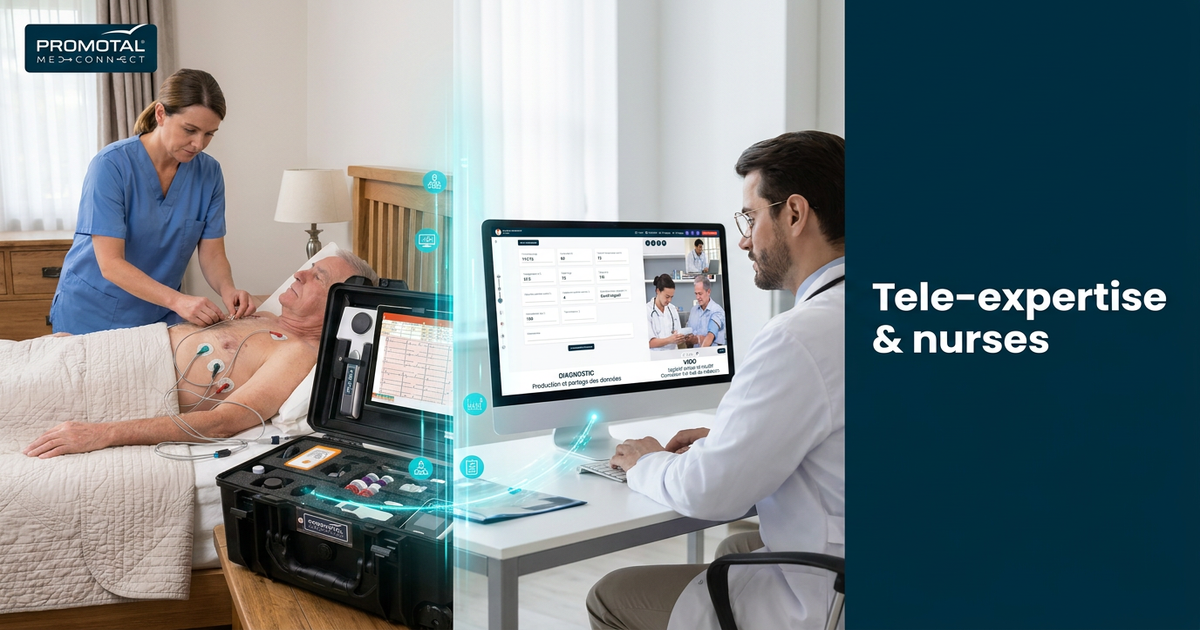
Can a nurse request a physician's opinion remotely about a patient and bill for it? Yes — that is exactly what teleexpertise allows. Since telemedicine was opened to all health professionals, a nurse (an IDEL or an advanced-practice nurse) can ask a physician for an opinion on a patient's situation — without that patient being present during the exchange. This article clarifies what teleexpertise is, how it differs from nurse-assisted teleconsultation and from telecare, the nurse's exact role, how connected equipment feeds a solid request for an opinion, and what to keep in mind about 2026 billing.
What is teleexpertise?
Teleexpertise is one of the telemedicine acts defined by the French Public Health Code. Its purpose is to let a health professional remotely request the opinion of one or more medical professionals, on the basis of their particular training or skills, using the health information related to a patient's care.
Its most important feature: teleexpertise takes place between health professionals, without the patient present. The physician consulted is not in direct contact with the patient. It also does not require video transmission: in practice the exchange goes through a secure health messaging system (MSSanté), with documents, photos or traces transmitted. That is precisely what distinguishes it from teleconsultation, where the physician sees and examines the patient remotely by video.
Requesting and responding party: who does what
Two roles structure the act:
- The requesting party is the health professional who asks for the opinion. This can be a physician… but also a paramedical professional, including a nurse.
- The responding party is the medical professional who gives the opinion: in practice a physician (and, in some cases, a midwife). This is the expert consulted.
In concrete terms, a nurse can be the requesting party of a teleexpertise but not the responding party: the nurse asks for the opinion, but does not provide it as a medical expert. The responding party draws up a report, archives it in the patient record, and sends it to the requesting party. Responsibility for the appropriateness of the act lies with the responding professional.
Teleexpertise, assisted teleconsultation, telecare: don't confuse them
Three practices are regularly mixed up. Here is the reading grid:
| Practice | Actors | Patient present? | Nature |
|---|---|---|---|
| Teleconsultation | Physician ↔ patient (video) | Yes, remotely | Telemedicine act |
| Assisted teleconsultation | Remote physician + patient assisted on site by a nurse | Yes, physically assisted | A variant of teleconsultation |
| Teleexpertise | Requesting professional ↔ responding physician | No | Telemedicine between professionals — medical opinion |
| Telecare | Nurse ↔ patient (video), no physician | Yes, remotely | Telecare act |
Nurse-assisted teleconsultation is therefore not teleexpertise: the patient is indeed present, assisted by the IDEL who performs the clinical examination while the physician consults remotely. Telecare is a care act performed remotely by the nurse themselves, without a physician. Teleexpertise is the only one of the three where the patient is not in the loop at the time of the act. To go further on assistance, see our guide to nurse-assisted teleconsultation.
The nurse's role in teleexpertise
Opening teleexpertise to medical auxiliaries, including nurses, results from Amendment 9 to the convention. On the nursing side, payment for the requesting nurse's teleexpertise was set out by Amendment 9 to the nursing convention. The IDEL or the advanced-practice nurse can therefore request a structured medical opinion: a dermatology opinion on a chronic wound that is not improving, reading a trace, or guidance when faced with an unexpected clinical sign during a home or nursing-home round. To organise this activity by role, see the telemedicine solution for nurses and IDELs.
Billing: what the nurse charges in 2026
For teleexpertise, the billing markers to remember are simple:
- Requesting party (physician or nurse): 10 EUR per teleexpertise, up to a maximum of 3 acts per patient per year.
- Responding party (the physician who gives the opinion): 25 EUR.
Teleexpertise is now open to all patients: the former restriction to priority patients only (long-term conditions, nursing homes, underserved areas, etc.) has been lifted. It is covered 100% by Assurance Maladie, with no upfront payment, no excess fees and no combination, and it is not subject to the 20% remote-activity cap that applies to telecare. For details on nurse payment, see our dedicated page on nurse billing and payment.
Don't confuse it with assisting a teleconsultation
When the nurse assists a patient during a teleconsultation (the patient is present, the physician consults remotely), this is not teleexpertise but an assistance act created by Amendment 6. Its billing depends on where it takes place:
| Code | Place of delivery | Fee |
|---|---|---|
| TLL | Dedicated / fixed location (nurse's office, multi-professional health centre…) | 12 EUR |
| TLD | At the patient's home | 15 EUR |
This is distinct from telecare (code TLS), which falls under Amendment 9: a care act performed remotely by the nurse themselves, without a physician (for example, remote wound follow-up by video). It is a separate act from assistance; for the eligible acts and the applicable fee, refer to ameli.fr. Note that, like any convention scale, these amounts may change; check the code and the amount in force on ameli.fr before billing. For reference, on the physician's side a general practitioner bills a teleconsultation at 25 EUR and a specialist at 30 EUR or more, depending on specialty and sector.
The connected equipment that makes teleexpertise relevant
A teleexpertise is only as good as the data transmitted. This is where connected equipment changes everything: a 12-lead ECG trace, a sharp dermatology photo taken with the dermatoscope, a vital-signs measurement, an otoscopy image. The more usable the data, the faster and more reliable the responding physician's opinion — this is especially true in telecardiology, where trace quality drives interpretation.
The MedConnect teleconsultation kit carries more than 20 medical-grade connected devices (Cardioline touchECG, Riester Ri-Sonic digital stethoscope, dermatoscope, otoscope, oximeter, vital-signs monitor…), designed for nurses on their rounds. The full range of teleconsultation equipment also comes as a telemedicine cart for nursing homes or as an ultra-light backpack. Data flows in real time into the teleexpertise platform, hosted under HDS (French health-data hosting certification), ISO 27001 certified and GDPR compliant — a decisive point when transmitting health data between professionals. Made in France, in Ernée (Mayenne), by Groupe Eloi (97 years of expertise), the equipment is CE-marked.
Cost and financing
The MedConnect kit is available from 3,000 EUR before tax. The cart is quoted on request. Above all, several subsidies ease the investment: Assurance Maladie pays 350 EUR per year for video-connection equipment and 175 EUR per year for connected medical devices. And when the project is part of a CPTS, ARS funding is possible: the net cost can then be brought down to as low as 0 EUR depending on the project. Our telemedicine financing page summarises these schemes, and our review of CPTS deployment details the territorial organisation.
FAQ
Can a nurse bill for a teleexpertise?
Yes, as the requesting party. The nurse (IDEL or advanced-practice nurse) bills the request for an opinion at 10 EUR, up to 3 acts per patient per year. The nurse cannot be the responding party: the medical opinion is given by a physician (and, in some cases, a midwife), who bills 25 EUR.
What is the difference between teleexpertise and assisted teleconsultation?
In assisted teleconsultation, the patient is present, assisted by the nurse who performs the examination while the physician consults remotely; the nurse then bills an assistance act (TLL in a dedicated location, 12 EUR; TLD at home, 15 EUR). In teleexpertise the patient is not present: it is an exchange of opinions between professionals, with no mandatory video, via secure messaging.
Is video required to perform a teleexpertise?
No. Teleexpertise does not require video transmission. It relies on transmitting health information (traces, photos, measurements, documents) via a secure health messaging system (MSSanté), which makes the quality of the connected equipment decisive for the relevance of the opinion.
Ready to discover MedConnect?
Request a personalized demo and see how the platform adapts to your practice.
Request a demo