Portable Bladder Scanner vs. Verathon BladderScan: Which Fits Telemedicine?
When clinical teams shop for a portable bladder scanner, one name comes up almost by default: Verathon's BladderScan/BVI line. It's the category-defining incumbent, and for good reason — Verathon has built a genuinely strong reputation for standalone ultrasound hardware in bladder volume and post-void residual (PVR) measurement. So it's a fair starting point for comparison, not a strawman. But "which device measures PVR most precisely" is only half the buying decision for a telemedicine program. The other half — often the more expensive half to get wrong — is what happens to that measurement after the scan: who sees it, how fast, and whether it lives inside the same workflow as your teleconsultation, your EHR notes, and your remote nursing team. This post compares our Vitascan LT and MD-6000P bladder scanners against the Verathon standard on that basis: not just "which scanner is more accurate," but which one fits a telemedicine deployment.
What to look for when comparing bladder scanners
Before comparing brands, it helps to separate the criteria that matter for any bladder scanner purchase from the criteria that matter specifically because you're deploying into a telemedicine or remote-care context:
- Scan technology and measurement method — 3D vs. 2D ultrasound, automatic volume calculation, and how the device handles common artifacts (ascites, prior surgery, obesity).
- Accuracy over the clinically relevant range — most PVR decisions happen well within a 0–999 mL range; check what tolerance the manufacturer publishes for handheld devices in that range.
- Portability and form factor — pocket-sized vs. cart-mounted vs. handheld-with-console changes who can carry it and where it gets used (bedside, home visit, satellite clinic).
- Ease of use / training curve — one-button scanning and an integrated screen matter more when the operator is a traveling nurse or a generalist rather than a dedicated sonographer.
- Image and data transfer — can the scan result and image leave the device (Wi-Fi, USB) and reach a chart or a remote clinician, or does it stay trapped on the unit?
- Battery life and duty cycle — relevant for home-health rounds, mobile units, and rural deployments without guaranteed charging access between patients.
- Total cost of ownership — device price plus any software, connectivity, or platform costs needed to make the data actually usable at scale.
- Fit with the rest of the care pathway — does the scanner operate as an island, or does it plug into the same system your teleconsultation, remote monitoring, and documentation already run on?
Hardware: comparable ground, real differences in form factor
On core measurement technology, this is a fair fight. Verathon devices are well-regarded, purpose-built ultrasound instruments, and clinicians who've trained on them will find the workflow familiar. Our two models compete on the same fundamentals with different trade-offs in size and setup:
- Vitascan LT Bladder Scanner — a portable, handheld unit using 3D ultrasound for volume measurement, sized for routine ward or clinic use where a dedicated scanning station makes sense.
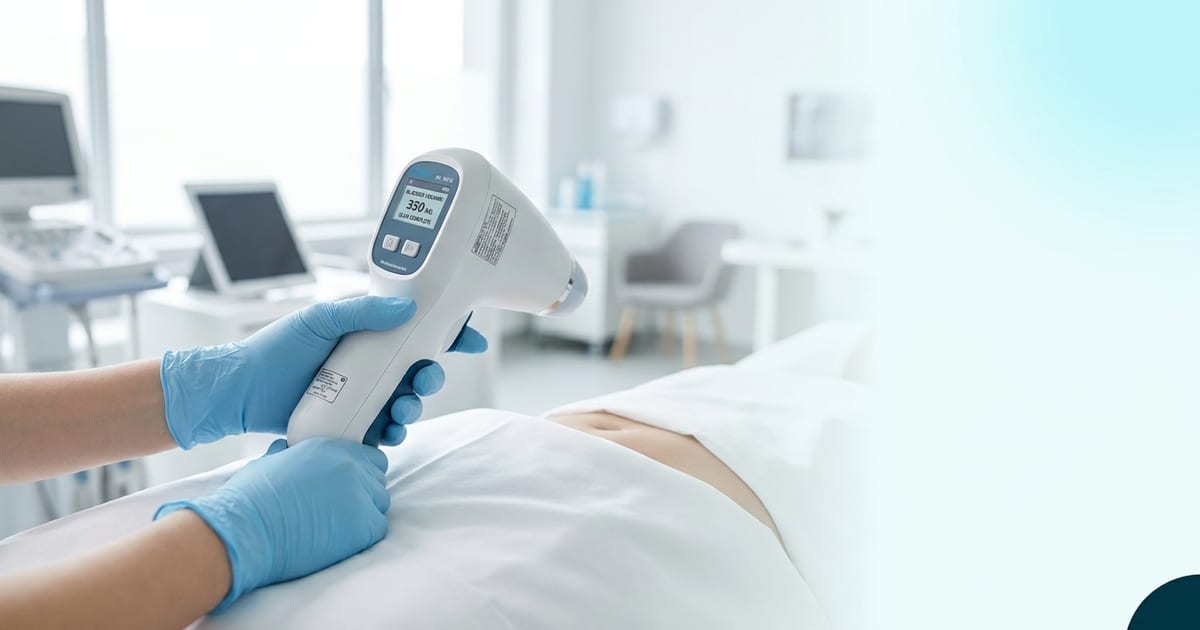
- MD-6000P pocket bladder scanner — genuinely pocket-sized, non-invasive, measures PVR via 3D ultrasound in seconds. Typical handheld accuracy is approximately ±15% or ±15 mL over a 0–999 mL range. It has a one-button scan, an integrated screen for immediate readout, Wi-Fi/USB image transfer, and a rechargeable battery rated for hours of continuous use — a practical fit for home-health visits, satellite sites, or any setting where you can't count on a cart following the clinician around.
Neither claim is a knock on Verathon's hardware. The honest framing is that all three are credible clinical instruments. The decision shouldn't be settled on scan quality alone — it should be settled on what happens next.
The real differentiator: telemedicine platform integration
This is where the comparison actually resolves. A Verathon device — like most standalone bladder scanners on the market, from any manufacturer — is built to be an excellent bladder scanner. It is not built to be a node in a telemedicine platform. Buy one, and the scan result and image are yours to move, store, and share by whatever process you build around it: manual upload, a separate PACS integration, a nurse re-keying values into an EHR.
Our Vitascan LT and MD-6000P are sold as diagnostic hardware for the same reason Verathon's are — but they're deployed inside the MedConnect telehealth platform, where a scan taken at the bedside or on a home visit becomes part of the same session record a remote physician reviews during a teleconsultation. That's the actual buying decision for a telemedicine program: not "whose ultrasound is 2% more precise," but "whose device turns a bedside measurement into data the remote care team can act on without a manual handoff." A standalone device purchase — Verathon's or anyone else's — solves the measurement problem. It doesn't solve the platform problem. If your bladder scanner needs to support remote nursing, satellite clinics, or teleconsultation workflows, the software it plugs into matters as much as the transducer. See the MedConnect telehealth platform for how device data, remote consultations, and documentation come together in one system.
How much does a portable bladder scanner cost?
Pricing depends on configuration — which model, what connectivity options, and whether it's deployed standalone or as part of a broader telemedicine kit alongside other diagnostic devices. We don't publish a flat number here because a pocket unit for a single home-health nurse and a cart-integrated scanner for a multi-site program aren't the same purchase. The most reliable way to get an accurate quote is to request one directly against the configuration you need: see current specs and request pricing on the Vitascan LT product page or the MD-6000P pocket bladder scanner page, or browse the full bladder scanner category to compare configurations side by side.
Frequently asked questions
Is a Verathon BladderScan better than a Promotal MedConnect bladder scanner? "Better" depends on the criterion. Verathon is a well-established, credible standalone ultrasound instrument. Our Vitascan LT and MD-6000P compete on core measurement technology and add native integration with the MedConnect telehealth platform — which matters specifically if the scanner needs to feed a remote-care or teleconsultation workflow rather than operate as a standalone device.
What is the accuracy of the MD-6000P pocket bladder scanner? Typical handheld accuracy is approximately ±15% or ±15 mL over a measurement range of 0–999 mL, using 3D ultrasound to calculate post-void residual in seconds.
Can a portable bladder scanner replace catheterization for PVR checks? For most routine PVR screening, non-invasive ultrasound scanning is the standard first step, reducing unnecessary catheterization; the underlying clinical decision protocol should be set by your care team, not the device alone.
Does the scan data connect to my EHR or telehealth records automatically? With the MD-6000P and Vitascan LT deployed inside the MedConnect platform, scan results and images can flow into the same session record used for teleconsultation and remote documentation, rather than requiring manual re-entry. A standalone device from any manufacturer, used outside that platform, typically requires a separate integration step.
What's the difference between the Vitascan LT and the MD-6000P? Both use 3D ultrasound for bladder volume/PVR measurement. The MD-6000P is pocket-sized with a one-button scan, integrated screen, and Wi-Fi/USB transfer — built for mobility (home visits, satellite sites). The Vitascan LT is a portable handheld unit suited to routine ward or clinic scanning. Compare full specs on each product page before deciding.
For buying criteria that apply across the whole category, see our portable bladder scanner buyer's guide. To see how bladder scanning fits into a full remote-care deployment, visit the MedConnect telehealth platform, or go straight to the bladder scanner category to compare models.
Next step: compare the MedConnect handheld bladder scanner range, review the two current models and request pricing for your deployment.
Ready to discover MedConnect?
Request a personalized demo and see how the platform adapts to your practice.
Request a demo