Nurse-Assisted Teleconsultation (IDEL): The Complete 2026 Guide
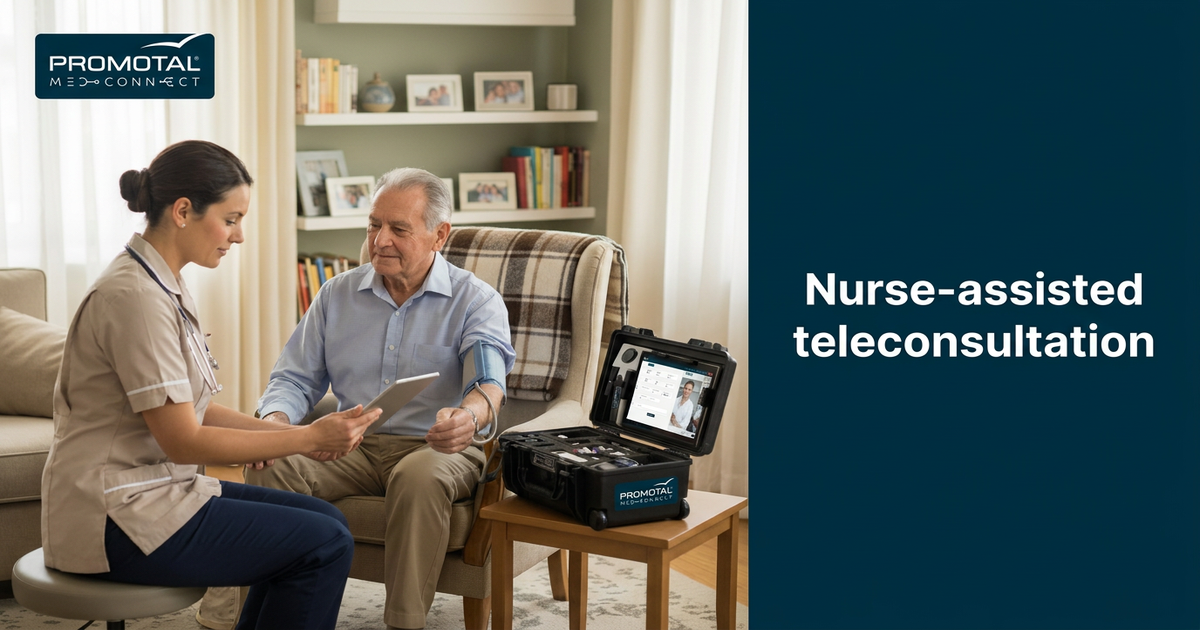
A nurse-assisted teleconsultation places a healthcare professional — most often a self-employed nurse (in France, an IDEL) — physically beside the patient while a doctor performs the consultation remotely. The doctor remains the one who consults and bills the medical act; the nurse accompanies the patient, performs the clinical examination on the doctor's instruction, transmits measurements, and bills a separate accompaniment act. For a nurse, this is an activity recognized and reimbursed since amendment 6 (avenant 6) to France's national nursing agreement. This complete 2026 guide answers every question doctors, nurses, and CPTS or care-home coordinators may have: what it is exactly, the nurse's role, how a session unfolds, what equipment to use, where it takes place, and how it is paid.
Nurse-assisted teleconsultation: what exactly are we talking about?
Télésanté (digital health) covers all remote care practices. It splits into two legally distinct branches: télémédecine, reserved for medical professionals (doctors), and télésoin (remote care), which covers remote acts performed by a pharmacist or a medical auxiliary, including the nurse. Distinguishing these clearly is essential, because they are not billed the same way.
- Simple teleconsultation: the patient is alone in front of the screen with the doctor, with no healthcare professional beside them.
- Assisted (accompanied) teleconsultation: the same medical act, but a nurse is present beside the patient for the clinical exam, measurements, and the technical side. The doctor bills the medical act; the nurse bills an accompaniment act.
- Télésoin (remote care): there is no doctor. The nurse personally delivers a remote care or follow-up act to the patient by video.
- Téléexpertise (remote expert advice): an opinion exchanged between two professionals about a patient who is not in the live loop.
To understand the overall framework and where each player fits, see our reference page on assisted teleconsultation. Nurses will find a dedicated overview of their practice on our solution for nurses page.
The nurse's role during the session
The nurse is not merely technical support: they are the doctor's eyes, hands, and ears at a distance. Concretely, during an assisted teleconsultation, the nurse:
- sets up and checks the secure video link and stays physically present with the patient;
- performs the clinical examination on the doctor's instruction (auscultation, guided palpation, inspection);
- transmits measurements and vital signs, and may use connected medical devices (ECG, digital stethoscope, oximeter, dermatoscope, otoscope, and so on);
- gives the doctor real-time clinical context on the patient's situation and progress;
- carries out, if needed, a prescribed medical act during the session.
The nurse practices in compliance with their professional rules and code of ethics. This presence transforms the teleconsultation: it goes from a simple video chat to a genuine remote clinical examination with objective data.
An assisted teleconsultation in 4 steps
1. Preparation and setup
The nurse prepares the station: secure connection, camera, and connected devices. The session must be done by video transmission under conditions that guarantee security, traceability, confidentiality of exchanges, and respect for the patient's privacy. A simple audio phone call, an SMS, or an email is not considered a teleconsultation.
2. Clinical data capture
The nurse takes vital signs, runs the requested exams, and transmits them to the doctor in real time. This is where connected medical devices make the difference: a 12-lead ECG or a digital stethoscope feed back reliable medical data the doctor could never have obtained over a plain video call.
3. The medical consultation
The doctor leads the consultation, questions the patient, guides the exam, and makes the diagnosis. The nurse acts as the link and performs the requested gestures.
4. Conclusion and follow-up
The doctor issues the prescription and the report; the nurse supports the patient on next steps. Each professional then bills the act that is theirs.
The equipment you need
The quality of an assisted teleconsultation depends directly on the equipment. You need a compliant video platform plus a set of connected, mobile medical devices. Promotal MedConnect, a French manufacturer based in Ernée (Mayenne) within Groupe Eloi (97 years of expertise), offers three formats depending on the use case:
- the teleconsultation kit, ideal for nurses' home visits;
- the telemedicine cart, designed for care homes and facilities;
- the ultra-light backpack for maximum mobility.
These formats carry more than 20 medical-grade devices (Cardioline touchECG 12-lead ECG, Riester Ri-Sonic digital stethoscope, dermatoscope, otoscope, vital-signs monitor, oximeter, portable ultrasound, spirometer, bladder scanner, and more) and rely on a software platform with HDS-hosted video, real-time device-data streaming, patient record, prescription, Carte Vitale billing, and AI scribe. The whole solution is CE-marked, GDPR-compliant, HDS-hosted, and ISO 27001-certified.
Where does assisted teleconsultation take place?
Assisted digital-health acts can take place in several settings: at the patient's home, in a dedicated teleconsultation location, during an already-scheduled care visit, or in a telemedicine booth or connected bus. More broadly, teleconsultation also occurs in equipped pharmacies, health centers, and structures such as care homes (EHPAD) and coordinated territorial organizations, notably CPTS. For chronic conditions, specialized uses are growing, for instance in tele-cardiology thanks to the connected ECG.
Coverage and billing: who bills what?
The principle is clear: the doctor bills the teleconsultation (the medical act) and the nurse separately bills their accompaniment act. On the doctor's side, a teleconsultation is billed at 25 € by a general practitioner and 30 € or more by a specialist, under the conventional terms in force. On the patient's side, the act is reimbursed at 70 % of the tariff (100 % for long-term conditions or equivalent situations), within the coordinated care pathway and with the usual direct-access exceptions.
The nurse's accompaniment act (avenant 6)
Amendment 6 (avenant 6) to the national nursing agreement created the role of teleconsultation accompanist, with billing effective from 1 January 2020. The accompaniment act is coded according to where it is performed:
| Code | Place of performance | Fee |
|---|---|---|
| TLL | Dedicated / fixed location (nurse's office, MSP, etc.) | 12 € |
| TLD | At the patient's home | 15 € |
These amounts are the conventional fees for the accompaniment act. Note that conventional tariffs may change over time. Amendment 9 (avenant 9), signed on 27 July 2022, consolidated and broadened this framework: it durably enshrined télésoin, allowed the nurse to request a téléexpertise, and extended accompaniment to teleconsultations requested by any medical professional (for example a midwife), not just a doctor.
Télésoin (TLS): a distinct act, with no doctor
Be careful not to confuse them: TLS corresponds to télésoin, a care act performed remotely by the nurse themselves, without a doctor, governed by avenant 9. It is not an accompaniment act. Télésoin requires the patient to be known to the nurse (at least one prior in-person act within the preceding twelve months). For the precise conditions and fees of télésoin, refer to ameli.fr.
Téléexpertise requested by the nurse
Since avenant 9, a nurse can request a téléexpertise from a medical professional. The requester (the one asking for the opinion, here the nurse) bills 10 €, up to a maximum of 3 acts per patient per year. The requested professional (the doctor who provides the opinion) bills 25 €. The patient is not present live. To go further, see our téléexpertise page and the dedicated guide on nurse téléexpertise (definition and billing). For the full detail of accompaniment acts, also read our article on billing assisted teleconsultation.
Equipment funding and getting started
France's Assurance Maladie supports nurses' equipment: under the conventional terms in force, an aid of 350 €/year is provided for video-connection equipment and 175 €/year for connected medical devices. The MedConnect kit is available from 3,000 € excl. VAT (the cart is quoted on request). In a CPTS context, ARS funding is possible: depending on the project, the net cost can be brought down to as little as 0 €. To estimate what you would pay, browse our telemedicine funding page.
To get started: choose the format suited to your practice, equip yourself with a compliant platform, train on the workflow, and structure cooperation with the doctors in your area. If you are in a CPTS, lean on our CPTS deployment guide and on the complete guide to nurse-assisted teleconsultation.
FAQ
What is the difference between assisted teleconsultation and télésoin?
In assisted teleconsultation, a doctor consults remotely and the nurse assists them beside the patient. In télésoin, there is no doctor: the nurse personally performs a remote care or follow-up act for the patient.
How much does the nurse bill for accompanying a teleconsultation?
The accompaniment act is coded by location: 12 € in a dedicated location (TLL) and 15 € at the patient's home (TLD), under the conventional terms in force, which may change.
Can a phone call replace video?
No. Assisted teleconsultation and télésoin must be done by video transmission under secure conditions. An audio-only call, an SMS, or an email is not considered a teleconsultation.
Ready to discover MedConnect?
Request a personalized demo and see how the platform adapts to your practice.
Request a demo