
Billing assisted teleconsultation by a nurse (2026)
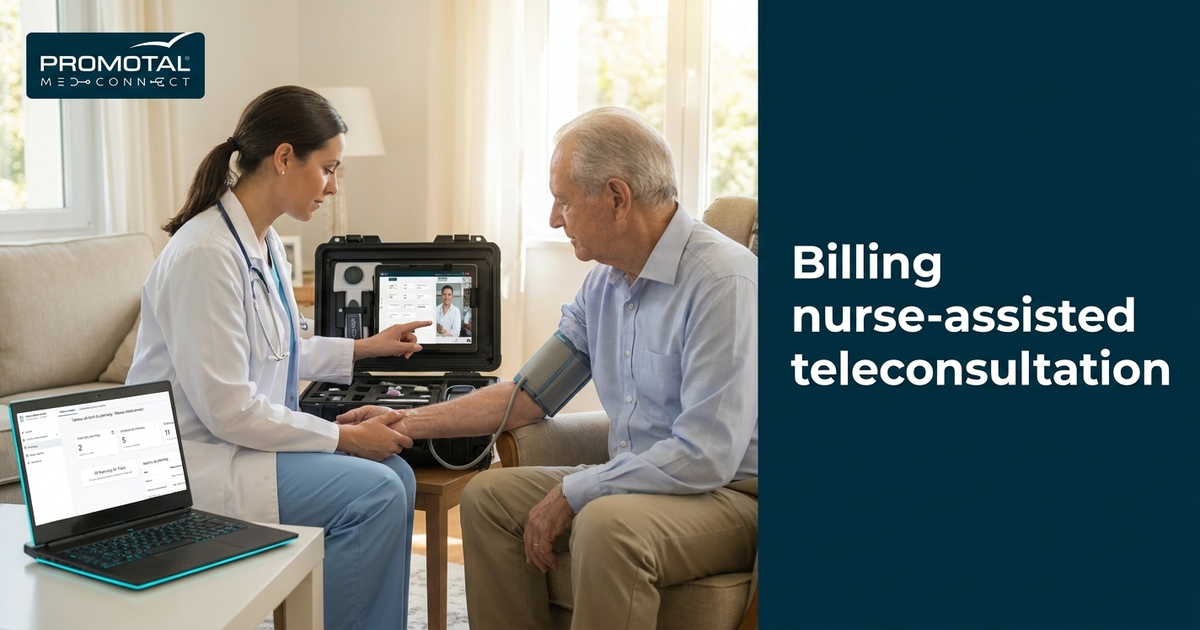
When a nurse assists a patient during a teleconsultation, one question comes up every time: who gets paid, and how? The answer fits in a single sentence — two professionals, two separate billings — but it requires keeping four concepts apart, because France's national health insurance (Assurance Maladie) treats them separately. This guide clarifies the billing and remuneration of nurse-assisted teleconsultation in 2026: the physician's amounts, the nurse's accompaniment codes, the telecare framework, tele-expertise, and equipment grants. One methodological note up front: the convention tariffs cited here may change through successive amendments; when in doubt, the references remain ameli.fr and the national nursing convention.
Four concepts you must not confuse
Before talking money, you need to fix the vocabulary. This is the heart of the matter and the source of most billing errors.
- Teleconsultation: a remote consultation performed by a physician (or midwife). The patient may be alone. The physician bills the act.
- Assisted teleconsultation: the patient is on video with a physician while a nurse is physically present to set things up, take measurements, perform the clinical exam, and manage the video. The physician bills the teleconsultation; in parallel, the nurse bills their own accompaniment act (amendment 6 to the nursing convention).
- Nurse telecare (télésoin): care delivered remotely by the nurse themselves, with no physician on video. The nurse is the professional who performs and bills the act (amendment 9).
- Tele-expertise: a professional remotely requests a colleague's opinion, asynchronously and without the patient. Physicians and, since 2023, nurses and advanced-practice nurses can be requesters.
Keep the structuring distinction in mind: in assisted teleconsultation, a physician and a nurse act together; in telecare, the nurse acts alone; in tele-expertise, two professionals exchange without the patient.
The physician's side: what they bill
The teleconsultation is billed by the physician at the same tariff as the in-person consultation of the same nature, reimbursed at 70% by Assurance Maladie within the coordinated care pathway. Concretely, a general practitioner bills €25; a specialist bills €30 or more, depending on their specialty and sector. The physician must respect the coordinated care pathway (with the usual exceptions: patients without a referring doctor, emergencies, minors, direct access to certain specialties, nursing homes, prisoners), use video (audio-only phone is excluded), obtain consent, and archive a report sent to the referring physician. Their teleconsultation activity is also capped at a share of their annual activity.
The nurse's side: the accompaniment codes (amendment 6)
This is where the nurse's added value lies. When a nurse assists the patient during a teleconsultation, they do not bill the physician's teleconsultation: they perform and bill their own accompaniment act, created by amendment 6 to the national nursing convention. Two separate claims therefore go to Assurance Maladie for the same session — the physician's, and the nurse's.
The accompaniment act is coded according to where the teleconsultation takes place. Two codes structure this billing:
| Code | Place of delivery | Tariff |
|---|---|---|
| TLL | Dedicated / fixed location (nurse's office, multidisciplinary health home, etc.) | €12 |
| TLD | At the patient's home | €15 |
In other words: assisted teleconsultation performed in a dedicated location is coded TLL at €12; performed at the patient's home, it is coded TLD at €15. Practical points to know: video transmission is required, the patient must have given consent, and — because the nurse is physically present with the patient — this accompaniment is not subject to the remote-activity cap that applies to telecare. To structure this activity day to day, MedConnect's telemedicine solution for nurses brings the connected devices and the video call together in a single workflow; our complete guide to assisted teleconsultation for nurses walks through a session step by step.
Nurse telecare: a distinct act
Telecare must not be confused with accompaniment. Introduced by amendment 9, telecare (code TLS) refers to care delivered remotely by the nurse themselves, with no physician on video: clinical monitoring after hospitalization for cardiac decompensation or COPD exacerbation, medication-adherence support, monitoring of a patient on insulin, or remote wound-dressing follow-up, for example. Unlike TLL/TLD accompaniment, telecare is not assistance to a medical consultation: it is the nurse who performs and bills the care. The exact telecare tariff is indexed to the nursing key-letter and is subject to scheduled revaluations; refer to ameli.fr for the current amount.
One condition deserves emphasis, because it is often misunderstood: telecare requires the patient to be "known" to the nurse (or to a nurse in the same group), with at least one act in the series performed in person. There is no "12-month" prior-knowledge rule for nurse telecare: that delay belongs to the physician teleconsultation framework and must not be transposed to it. Video transmission is mandatory, a report is archived, and telecare activity is capped at a share of the nurse's activity.
What about tele-expertise?
Tele-expertise is an asynchronous act, without the patient, between two professionals. The requester — the one seeking the opinion, who may be a nurse or an advanced-practice nurse — bills €10, within a limit of 3 acts maximum per patient per year. The responder, the physician who provides the opinion, bills €25. The patient is not present and the act is covered without out-of-pocket payment. Tele-expertise is an excellent complement to nurse accompaniment for securing a specialist opinion: see our tele-expertise page and the dedicated nurse tele-expertise guide.
Equipment grants: your kit can cost you €0
Act remuneration is only part of the equation. Assurance Maladie also supports nurses' equipment. Under the lump-sum modernization grant, two amounts can be combined each year: €350/year for the video-connection solution (video transmission) and €175/year for connected medical devices, declared during the annual campaign. On the physician side, the digital-equipment grant is being overhauled in 2026 (transition to a digital allowance); the exact amounts for physicians are not confirmed at this stage and should be verified with Assurance Maladie.
Beyond these individual grants, Regional Health Agencies (ARS) fund telemedicine projects through the Regional Intervention Fund, via regional calls for projects; amounts and criteria vary from one region to another and are not a systematic individual grant. Within a CPTS (coordinated primary-care community) project, this structural funding can, depending on the project, bring the net cost of equipment for the caregiver down to €0. That is the decisive return-on-investment angle: the MedConnect teleconsultation kit starts from €3,000 excl. tax, and once you combine the annual lump-sum grants with ARS funding in a CPTS, the remaining cost can be sharply reduced, or even brought to zero. To map every source you can tap, see our telemedicine financing page and, for territory-wide projects, our piece on rolling out teleconsultation in a CPTS.
Summary: who bills what
| Situation | Who bills | Amount |
|---|---|---|
| Teleconsultation (general practitioner) | Physician | €25 |
| Teleconsultation (specialist) | Physician | €30 or more |
| Accompaniment in a dedicated location (TLL) | Nurse | €12 |
| Accompaniment at the patient's home (TLD) | Nurse | €15 |
| Nurse telecare (TLS) | Nurse | See ameli.fr (amendment 9) |
| Tele-expertise — requester (incl. nurse) | Requester | €10 (max 3 acts/patient/year) |
| Tele-expertise — responder (physician) | Responder | €25 |
| Nurse equipment grant (annual) | — | €350/yr + €175/yr |
Well equipped and well financed, the nurse becomes a central player in access to care across their territory. MedConnect's teleconsultation equipment and software platform, HDS-certified and GDPR-compliant, are built for exactly that role.
FAQ
Do both the nurse and the physician bill during an assisted teleconsultation?
Yes. These are two separate acts for the same session: the physician bills the teleconsultation (€25 for a GP, €30 or more for a specialist) and the nurse bills their accompaniment act (amendment 6), depending on the location: TLL at €12 in a dedicated location, TLD at €15 at the patient's home.
What is the difference between assisted teleconsultation and nurse telecare?
In assisted teleconsultation, a physician runs the remote consultation while the nurse physically assists the patient; the nurse bills TLL (€12) or TLD (€15) depending on the location (amendment 6). In telecare (code TLS, amendment 9), the nurse delivers the care remotely themselves, with no physician on video. Telecare requires a "known" patient, with at least one act in the series performed in person — there is no "12-month" rule.
Can equipment really cost €0?
It depends on the project. The lump-sum nursing grants (€350/year for video connection, €175/year for connected devices) already cut the remaining cost every year. Within a CPTS, structural ARS funding can, depending on the project, bring the net cost of equipment down to €0. The MedConnect kit starts from €3,000 excl. tax.
Ready to discover MedConnect?
Request a personalized demo and see how the platform adapts to your practice.
Request a demo