
Portable Bladder Scanner: How to Choose (2026 Buyer's Guide)
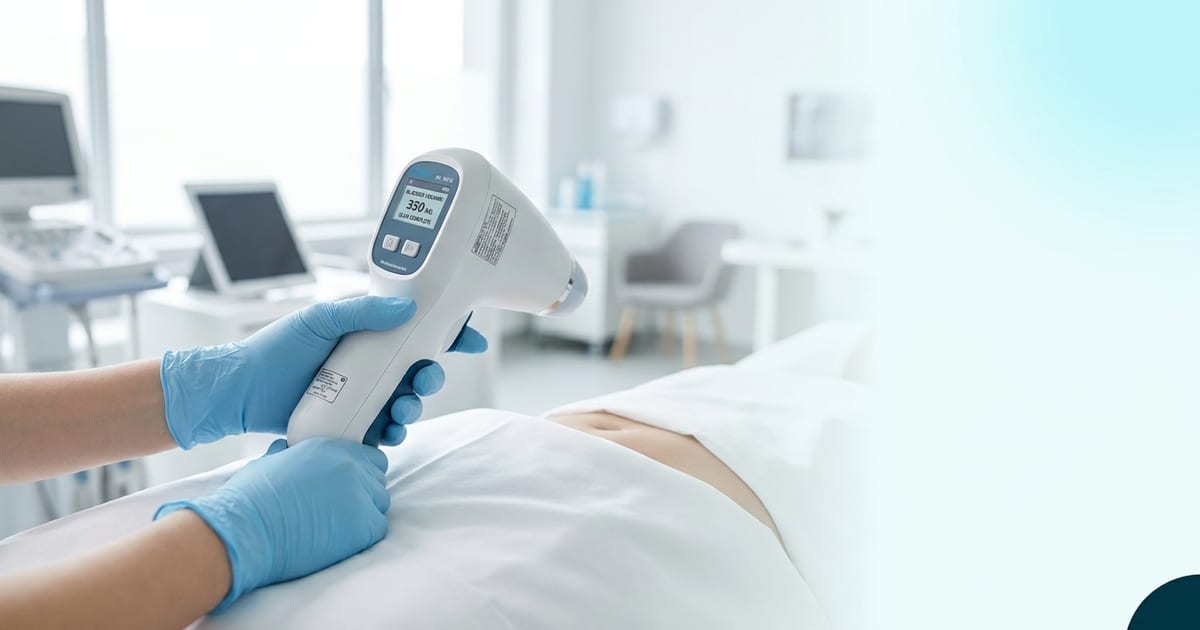
Short answer: to choose a portable bladder scanner, a healthcare organization should compare eight factors: the documented accuracy and the evidence behind it, the measurement range, scan time and ease of use, probe technology (3D versus 2D), form factor and battery, data export and EHR fit, cleaning and durability, and total cost of ownership. Manufacturer accuracy specifications for current scanners range from ±3% to ±15%, and a 2025 review of 22 studies found no clinically significant difference between a bladder scanner and catheterization for measuring bladder volume. None of the four scanners compared below has a published list price; all are sold on quote.
A portable bladder scanner is a handheld ultrasound device that measures bladder volume, especially post-void residual (PVR), non-invasively, in seconds, at the bedside. It helps clinicians decide whether catheterization is actually needed, avoiding unnecessary catheters and the infections they cause. This guide explains how to choose one, compares the main models on the market in 2026, and shows where a scanner fits in urology, post-op, geriatric, home and telemedicine care.
How to choose a portable bladder scanner: 8 factors to consider
- Accuracy, and the evidence behind the number. Ask for the stated tolerance and how it was measured. Most specifications are read on tissue-equivalent phantoms, not patients: ±7.5% above 100 mL is common for dedicated 3D scanners, ±15% or ±15 mL for compact pocket units, and one vendor states ±3% above 100 mL. Clinical evidence is reassuring for the device category: a 2025 review of 22 studies (Manfredini et al., French Journal of Urology) found no clinically significant difference between catheterization, bladder scanners and conventional ultrasound, and no accuracy difference between scanner types. In 101 women, a 3D portable scanner correlated with catheterized volume at r = 0.79 with a mean difference of 12.9 mL (Al-Shaikh et al., 2009). Know the limits too: in 70 patients with pelvic organ prolapse, scanner and catheter PVR differed by only 1.4 to 5.9 mL on average, but error increased with stage III/IV prolapse (Theisen et al., 2019). The same review stresses that knowing the patient's medical history is key to interpreting a reading.
- Measurement range. Most scanners read 0 to 999 mL; some go to 1,000 mL or, per one vendor, above 1,400 mL. If you manage acute retention, ask what the device displays when the bladder exceeds its range.
- Scan time and ease of use. Current devices return a volume in a few seconds. What separates them is how quickly a non-specialist nurse gets a reliable reading: one-button scanning, automatic bladder location and on-screen aiming guidance reduce repeat scans. CDC guidance on preventing catheter-associated urinary tract infections asks facilities that use bladder scanners to state indications clearly and train nursing staff (CDC CAUTI recommendations II.H), so factor training time into the choice.
- Probe technology: 3D versus 2D. A 3D sweep is more forgiving of probe placement than a single plane. In a 2025 prospective study of 53 adults scanned by novice operators, a handheld 3D method had a median volume error of about -11% to -12% versus -28% to -37% for manual 2D measurement, with higher inter-operator agreement (ICC 0.977 vs 0.927) (Alfuraih et al., Diagnostics). Adjustable scan depth (for example 10 cm for children, 16 cm for adults, 23 cm for larger adults) helps across patient sizes.
- Form factor and battery. Decide between a pocket device with its own screen, a probe that runs on a tablet, and a cart-based workstation. Count scans per shift and check battery life: our MD-6000P documents up to 6 hours; cart systems typically rely on onboard charging or swappable batteries. Weight and a holster or case matter for home visits.
- Data export and EHR fit. Check how the result reaches the record: Wi-Fi transfer, JPEG or DICOM reports, a printout, or barcode-based charting. For telemedicine, the measurement should be visible to the remote clinician during the consultation, not re-typed afterwards.
- Cleaning, durability and service. The CDC recommends that scanners be cleaned and disinfected between patients, so confirm which disinfectants the housing tolerates and the ingress rating (IPX1, IPX4, IPX7 and so on). Ask about drop resistance, calibration requirements and turnaround for repairs or loaner units.
- Total cost of ownership. Compare more than the purchase price: warranty length, service plans, spare probes and batteries, software or subscription fees, training, and the number of units needed per ward or team. Weigh that against the catheters, catheter kits and infection risk the scanner helps you avoid.
To see these criteria applied to two documented models, compare the MedConnect handheld bladder scanner range.
Best portable bladder scanners in 2026 compared
There is no single best bladder scanner: the right choice depends on the care setting, who scans, and where the result needs to go. The table summarizes what each manufacturer states publicly for four current models. It is a fact sheet, not a ranking.
| Criterion | Verathon BladderScan i10 | EchoNous Kosmos Bladder | MedConnect MD-6000P (pocket) | MedConnect Vitascan LT |
|---|---|---|---|---|
| Format | Cart-based system: 10.1-inch touchscreen console on a mobile workstation with a 3D probe | Handheld ultrasound probe used with a Kosmos tablet; can expand to general point-of-care ultrasound | Pocket scanner with integrated display; works without a computer | Dedicated portable 3D bladder scanner |
| Stated accuracy | ±7.5% on 100–999 mL, ±7.5 mL on 0–100 mL (tissue-equivalent phantom) | ±3% above 100 mL, ±3 mL below 100 mL (tissue-equivalent phantom); vendor reports r = 0.988 in a 146-participant clinical study | ±15% or ±15 mL | ±7.5% above 100 mL, ±7.5 mL below 100 mL |
| Measurement range | 0–999 mL | 4 mL to over 1,400 mL | 0–999 mL | 0–1,000 mL |
| Scan technology | ImageSense AI with 3D probe; volume "within seconds"; automatic bladder location | AI bladder workflow; solid-state probe with no moving parts | 3D acquisition, 2.5 MHz, scan depth up to 20 cm | 3D probe, 2.6 MHz, depths 10/16/23 cm, automatic bladder location and tracking |
| Battery | Onboard charging and user-swappable battery; hours not stated | Not stated | Up to 6 hours | Not stated |
| Data and records | Charting tool records results via existing EHR barcode wands; no IT network connection required | Not stated | Wi-Fi to computer or tablet; Windows and Android reporting software | Full-page JPEG and DICOM reports with PVR calculation |
| Cleaning and durability | Plastics designed for fast-kill disinfectants; IPX4 probe, IPX2 console; drop-tested probe; no routine calibration | Not stated | IPX1; CE 0123 | IPX7; CE |
| Warranty | Warranty and service plans; terms not stated | 5 years | Not stated on product page; terms given in the quote | Not stated on product page; terms given in the quote |
| Published price | Not stated (quote-based) | Not stated; vendor states no subscription fees | Not stated (quote-based) | Not stated (quote-based) |
Competitor facts were read from each manufacturer's public website on 1 October 2026. Specifications change; if something here is out of date, tell us through our contact form and we will correct it.
For a deeper look at one of these matchups, read our MedConnect vs Verathon BladderScan comparison, which focuses on telemedicine deployments.
Where MedConnect fits, and where it does not
Our two scanners suit mobile nursing teams, home care, nursing homes, clinics and telemedicine programs, where a compact device and a shared result matter most. The MD-6000P is the pocket option for clinicians on the move; the Vitascan LT adds tighter stated accuracy, a 1,000 mL range and DICOM reports. Both can be deployed with the MedConnect telehealth platform so the scan joins the other diagnostic data in the consultation. If you are standardizing a large hospital fleet on cart-based scanners with barcode charting, or want one probe that also covers cardiac, lung and vascular point-of-care ultrasound, the cart and multi-purpose options above are designed for those jobs.
What is a portable bladder scanner?
A bladder scanner is a non-invasive ultrasound device that images the bladder and calculates urine volume automatically. A portable (handheld) bladder scanner does this without a cart or a PC: place the probe on the lower abdomen, press once, and read the volume on the integrated screen in a few seconds. It is used to measure post-void residual, assess urinary retention and guide intermittent catheterization.
How a bladder scanner works
The probe emits ultrasound, builds a 3D picture of the bladder and computes the volume from the scanned dimensions. Modern handheld scanners give a result in seconds, with no consumables beyond ultrasound gel and no preparation. Because it is non-invasive, it can be repeated as often as needed, unlike catheterization, which is invasive and carries infection risk.
Where it is used
Bladder scanners are everyday tools in urology, post-operative recovery, geriatrics and nursing homes, neuro-rehab, and increasingly in home and telemedicine care, where a nurse scans the patient and shares the result with a remote physician. In a connected setup, the scan joins the other diagnostic data on one screen during the consultation. Note that these are professional medical devices: they are sold to healthcare organizations and used by trained clinicians, including home-care nurses, rather than bought by patients for self-monitoring.
Bladder scanner vs catheterization
Catheterization is invasive, uncomfortable and a leading cause of healthcare-associated urinary tract infections. A bladder scan answers the same question, how much urine is in the bladder, without any of that, so catheters are placed only when truly necessary. The CDC recommends considering a portable ultrasound device for patients undergoing intermittent catheterization to reduce unnecessary catheter insertions, which is why bladder scanners are a standard part of catheter-reduction protocols.
How much does a portable bladder scanner cost?
Portable bladder scanners are quoted by model and configuration rather than sold at a fixed list price; none of the four manufacturers in the table above publishes one. The quote depends on the device (probe technology, 3D, screen, connectivity), accessories, the number of units, warranty and service terms, and whether it is bundled with a telemedicine platform. Budget for the full cost of ownership, not just the device. Compare our handheld models, the Vitascan and the MD-6000P pocket scanner, or request configured bladder scanner pricing; our team responds within one business day.
Frequently asked questions
How should a healthcare organization choose a portable bladder scanner? Compare eight factors: stated accuracy and how it was measured, measurement range, scan time and ease of use for non-specialist staff, 3D versus 2D probe technology, form factor and battery life, data export and EHR fit, cleaning and durability, and total cost of ownership. Then match the format to the setting: pocket devices for mobile and home-care teams, cart systems for large hospital fleets, connected models for telemedicine.
What is the best bladder scanner? There is no single best model. Peer-reviewed studies show no meaningful accuracy difference between scanner types, so the best bladder scanner is the one that fits your workflow: who scans, where, how many scans per shift, and how the result reaches the patient record or the remote clinician.
How much does a portable bladder scanner cost? Prices are quote-based: Verathon, EchoNous and MedConnect do not publish list prices on their websites. The total depends on the model, accessories, number of units, warranty and service terms, software or subscription fees, and any telemedicine platform bundle. Request a quote for a configured price.
How accurate is a handheld bladder scanner? Manufacturer specifications range from ±3% to ±15%, usually measured on phantoms. In clinical studies, bladder scanners show no clinically significant difference from catheterization for bladder volume, with mean differences of roughly 1 to 13 mL in published comparisons. Accuracy drops in some patients, such as advanced pelvic organ prolapse.
Why use a bladder scanner instead of catheterization? A scan measures bladder volume non-invasively in seconds, so catheters, which are invasive and a major source of urinary tract infections, are used only when necessary.
Can a bladder scanner be used in telemedicine or at home? Yes, by a professional. A nurse can scan the patient at the bedside or at home and share the result with a remote physician; connected models transmit the measurement into the consultation. Bladder scanners are clinical devices sold to healthcare organizations, not consumer products for self-use.
What is post-void residual (PVR)? PVR is the volume of urine left in the bladder right after voiding. A bladder scanner measures it non-invasively to assess urinary retention and guide care.
Explore our portable bladder scanners, the Vitascan and the MD-6000P, or see all connected diagnostic devices.
Ready to compare models or request a quote? Visit the handheld and portable bladder scanner range for a side-by-side comparison of the MD-6000P and Vitascan LT, documented specifications and configured pricing.
Ready to discover MedConnect?
Request a personalized demo and see how the platform adapts to your practice.
Request a demo