The 5 Telemedicine Acts Recognised by French Law: Complete Guide
The word "telemedicine" is often used as if it described a single concept — little more than a video call with a doctor from your sofa. In reality, French law distinguishes five distinct acts, each addressing different clinical situations and involving healthcare professionals under specific conditions.
Since the decree of 19 October 2010, adopted under the HPST Act and codified at article R6316-1 of the French Public Health Code (Code de la santé publique), these five acts are the only ones legally recognised as telemedicine acts in France. Understanding them means better structuring a telehealth programme, choosing the right tools, and addressing the real needs of your patients and your teams.
1. Téléconsultation: remote medical consultation
This is the most widely known and practised act. Téléconsultation allows a physician — GP or specialist — to conduct a consultation remotely with a patient. The patient may be alone or assisted by another healthcare professional (nurse, pharmacist, coordinating physician).
As of 2024, approximately 13.9 million teleconsultations were performed in France, up nearly 20% from 2023, according to Assurance Maladie data. Reimbursement is identical to an in-person consultation: 70% of the conventional tariff covered.
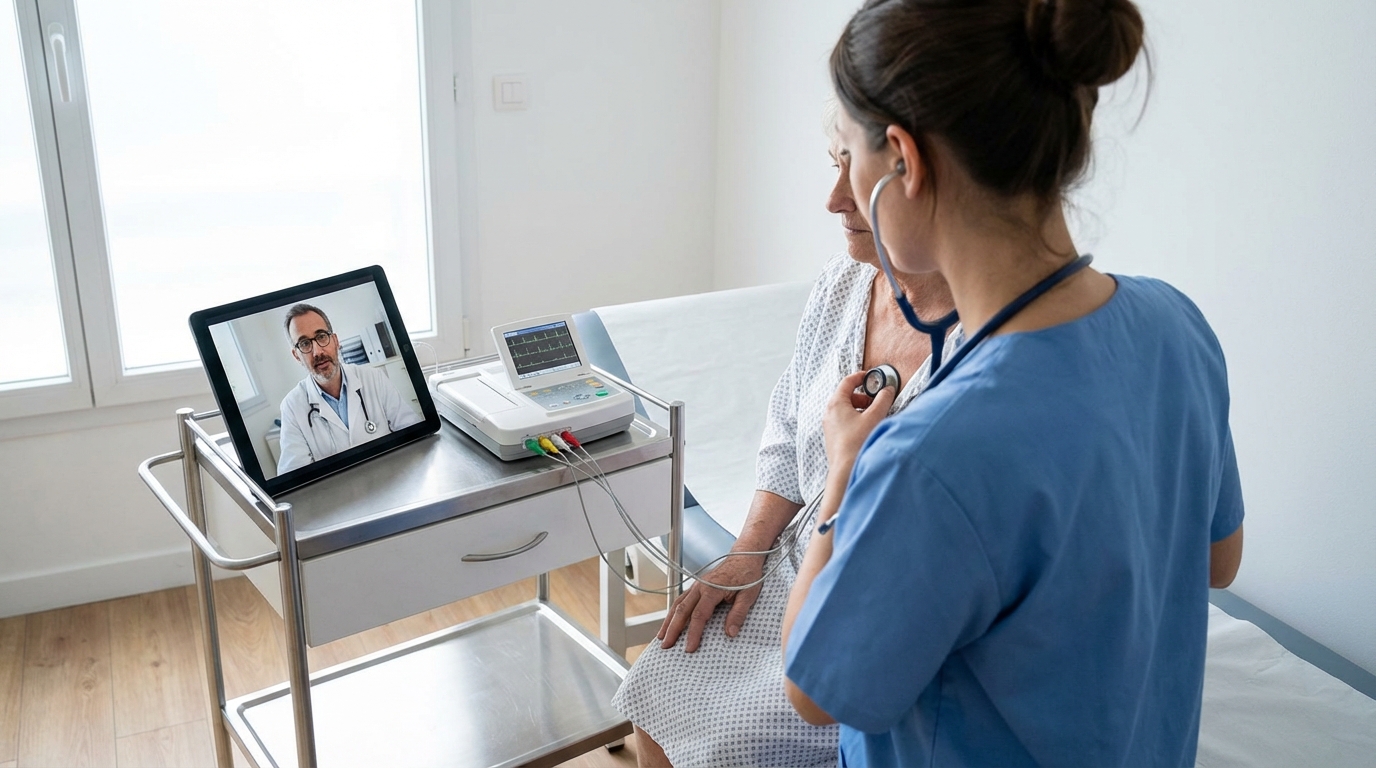
But a quality teleconsultation is not just a video call. In equipped facilities, the remote physician can receive real-time data from diagnostic devices — 12-lead ECG, digital stethoscope auscultation, vital signs — uploaded directly to the patient record. This is precisely what a platform like MedConnect enables, where connected medical device data integrates natively into the consultation, with no manual re-entry.
2. Téléexpertise: specialist opinion between professionals
Téléexpertise allows a "requesting" physician to seek the remote opinion of one or more "expert" colleagues, based on a patient's clinical data. Unlike téléconsultation, the patient is not necessarily present during the exchange.
In practice: a GP sends an ECG or dermatological images to a cardiologist or dermatologist to obtain an opinion before referring their patient. The exchange takes place via a secure health messaging system. Téléexpertise has been reimbursed since 2019 at levels 1 and 2 (depending on case complexity).
It is particularly valuable in under-served areas, where accessing a specialist in person can take weeks. For a deeper look, the benefits of tele-expertise for healthcare professionals are worth exploring in detail.
3. Télésurveillance médicale: remote patient monitoring
Télésurveillance médicale involves collecting health data remotely from a patient — at home, in a nursing home, or in their place of residence — so that the physician can interpret it and adjust the care plan if necessary.
It primarily concerns patients with chronic conditions: heart failure, diabetes, respiratory failure, hypertension. The physician does not perform a care act at the time of reading the data, but makes therapeutic decisions based on the information received.
Remote monitoring is the act that demands the most rigour on the device side: data must be reliable, timestamped, and traceable in the medical record. A complete guide on remote patient monitoring with connected devices can help structure this component in your organisation.
4. Téléassistance médicale: remote guidance during a care act
Less frequently discussed, téléassistance médicale is nevertheless essential in certain contexts. It allows a medical professional to remotely assist another healthcare professional during the performance of a care act.
A concrete example: a surgeon remotely guides a nurse performing a technical procedure in an isolated area, or a senior physician accompanies an intern in real time during a procedure. The act is synchronous — both professionals are connected simultaneously — and requires high-quality video transmission.
This act is less documented in public statistics, but its relevance is real in telemedicine programmes deployed in contexts of limited mobility or human resources.
5. Régulation médicale: remote emergency medical response
Régulation médicale is the telemedicine act performed by the emergency dispatch centres (SAMU, Centres 15). It refers to the remote medical response to an emergency situation: the regulating physician assesses the severity of the call, directs the patient to the appropriate care pathway, and decides whether to dispatch emergency services.
This is a familiar act but one that is often overlooked in discussions about telemedicine. It is, however, one of the oldest and most structured applications of remote medicine in France.
What the five acts have in common — and what sets them apart
All of these acts are medical acts: they can only be performed by an authorised medical professional, they must be documented in a report, and they engage the practitioner's professional liability. All also require technical conditions guaranteeing data security and confidentiality.
This last point is not trivial. Telemedicine compliance — GDPR, ISO 27001, HDS — is a legal requirement, not an option. Organisations deploying telemedicine programmes must ensure their platform meets these standards.
Where the five acts diverge is in their clinical nature: some are synchronous (téléconsultation, téléassistance, régulation médicale), others can be asynchronous (téléexpertise, télésurveillance). Some directly involve the patient; others do not. This diversity calls for technical solutions adapted to each use case.
A platform like MedConnect is designed to cover several of these acts within a single environment — from integrated tele-expertise to real-time diagnostic device data during consultation — without multiplying tools or connections.
If you are thinking about structuring or expanding a telemedicine programme, clearly identifying which acts you wish to cover is the first step. The needs of a rural primary care network are not the same as those of a specialist clinic or a chronic disease monitoring programme. Starting from the legal framework means starting on solid ground.
Ready to discover MedConnect?
Request a personalized demo and see how the platform adapts to your practice.
Request a demo