Telemedicine for Rural Healthcare: How Connected Devices Bring Specialist Care to Underserved Communities
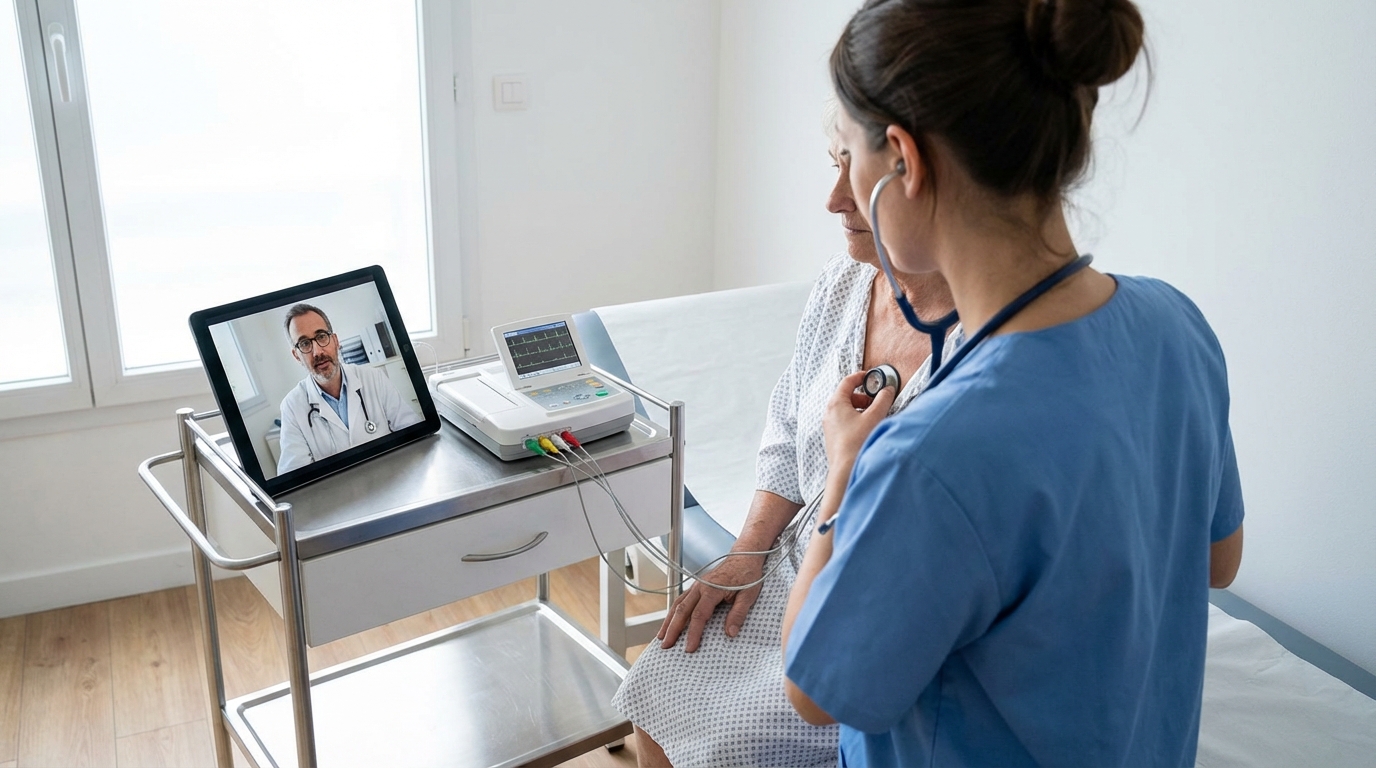
Short answer: a rural clinic or hospital can offer specialist-level consultations without a specialist on site when an on-site nurse or other telepresenter examines the patient with connected medical devices—ECG, digital stethoscope, vital signs monitor, otoscope and exam camera—while the remote physician joins by secure video and sees the measurements live. The device data is what turns a video call into a clinical examination.
This guide explains what a rural remote exam setup needs in 2026: the device categories, the three deployment formats (fixed station, cart, portable kit), how the workflow runs, what to check on security and integration, and how US rural programs are funding equipment.
Why video alone is not enough in rural care
Rural communities in the United States face longer travel distances, fewer specialists and workforce shortages; the federal Rural Health Information Hub keeps an up-to-date overview of these access barriers and of telehealth's role in addressing them (RHIhub: Telehealth and Health IT in Rural Areas). A video-only visit helps with history taking, follow-up and behavioral health, but many decisions—chest pain, a new murmur, an ear infection, a skin lesion, an unstable patient—need examination data. Without it, the remote physician often ends the call with "get an ECG and call back."
The connected devices a rural exam room needs
A practical baseline covers the measurements a physician asks for most often. In MedConnect's US basic kit each device streams to the consultation or attaches its report automatically:
| Need | Device | What the remote physician gets | US regulatory status |
|---|---|---|---|
| Vital signs | Edan iM3s handheld monitor | NIBP, SpO₂, pulse, optional temperature | FDA-cleared, 510(k) K202892 / K233038 |
| 12-lead ECG | Edan SE-1515 (DX12 wireless or DP12 USB) | PDF report with Glasgow interpretation, attached to the record within seconds | FDA class II, 510(k) K152427 |
| Auscultation | Riester ri-sonic USB stethoscope | Live heart and lung sounds | FDA-cleared, 510(k) K132560 |
| ENT and skin | Firefly digital otoscope or exam camera | Live video and still images | FDA-registered (class I, 510(k)-exempt) |
Programs add devices by specialty—spirometry, dermatoscopy, point-of-care ultrasound—once the core workflow is running. The full catalog is on our telehealth equipment page.
Three deployment formats
- Fixed telehealth station in a dedicated room of a rural health clinic, FQHC site, library, school or workplace: always ready, nothing to carry. See nurse-led telehealth center.
- Telehealth cart that rolls to the bedside or the emergency department of a rural or critical access hospital. See telehealth cart.
- Portable kit for home visits, outreach and mobile clinics, carried by one nurse. See telehealth kit and the kit vs cart comparison.
How a remote exam visit runs
- The telepresenter registers the patient and opens the consultation.
- The remote physician joins by end-to-end encrypted video; a second stream shows the otoscope or exam camera.
- Guided by the physician, the telepresenter takes vital signs, records the ECG and places the stethoscope; the data appears on the physician's screen as it is captured.
- The physician documents the assessment and plan; device reports stay in the consultation record.
- Where live video is not practical, the same data can be collected and sent for later review (store-and-forward).
The role of the on-site person is central; our assisted teleconsultation page details it.
Where it fits in US rural care
- Rural and critical access hospitals: specialty consults at the bedside or in an outpatient room without hiring the specialist—see telehealth for rural hospitals.
- Rural health clinics and FQHCs: share scarce physician time across sites with a nurse presenting the patient—see RHC and FQHC telehealth.
- Home health and mobile care: a portable kit lets the physician examine the patient during a nurse home visit—see remote exam kit for home health.
Connectivity
Live examination needs a stable connection for two video streams plus device data. Validate bandwidth at each site before deployment; where it is intermittent, plan store-and-forward visits for non-urgent cases. Broadband programs such as the FCC's Rural Health Care Program help eligible providers with connectivity costs.
Security, records and billing
- MedConnect is HIPAA-ready: US deployments run under a signed Business Associate Agreement, with US customer data hosted on AWS in the United States. The platform's information security management system is ISO 27001:2022 certified. Details on our compliance page.
- Device reports and consultation records can be exchanged with your EHR through standard interfaces (HL7, GDT, FHIR R4 for vital signs data, API).
- MedConnect does not do billing. Your organization keeps its own EHR and billing software; telehealth coverage rules vary by payer and state—see the Center for Connected Health Policy and telehealth.hhs.gov.
Funding the equipment
Under the Rural Health Transformation Program, states are re-granting federal funds to rural providers and community sites, and several state programs list telehealth equipment such as stethoscopes, otoscopes, exam cameras and vital signs devices among eligible supplies. Eligibility is set by each state program. Our RHTP telehealth equipment guide explains how the money flows, what is typically excluded and how to prepare a grant-ready quote. Other sources include USDA Distance Learning and Telemedicine grants and HRSA telehealth programs.
Deployment and support
MedConnect ships the configured station, cart or kit directly to the site, trains the team remotely and provides remote support. It is used in France and six other countries, including the United States, where a customer runs at-home consultations in partnership with clinics. There are no public list prices: the quote depends on the format, the device set, the number of sites and users, and integration needs. Request a configured quote.
Ready to discover MedConnect?
Request a personalized demo and see how the platform adapts to your practice.
Request a demo