Telehealth in Nursing Homes: 5 Real Outcomes from 2026 Deployments
Why Nursing Homes Are Deploying Telehealth at Scale in 2026
The problem in long-term care is not a lack of interest in telehealth. It is that most platforms were never built for it.
Video call tools do not stream a 12-lead ECG. Scheduling software does not generate a SOAP note. Hardware vendors do not include an EMR. The result is three or four tools that do not talk to each other, staff spending more time on data entry than on patients, and remote doctors making clinical decisions without the data they actually need.
That gap is closing. Facilities that have deployed integrated telehealth platforms in 2026 are reporting concrete, measurable results — and this article covers five of them.
These are not projections. They reflect what happens when a nursing home runs a real clinical consultation, not a video call.
Outcome 1: Fewer Emergency Transfers, More Decisions Made On-Site
Unnecessary emergency department transfers are among the most expensive and disruptive events in nursing home care. A resident deteriorates, the on-site nurse cannot reach a doctor, and the default response is an ambulance.
When a remote doctor can see live vital signs, hear a digital stethoscope feed, and review a freshly uploaded ECG within the same consultation, that calculus changes. They have enough clinical information to make a real decision — adjusting medication, ordering a test, or escalating appropriately. It is an informed call, not a precautionary transfer.
Facilities that have moved from video-only teleconsultation to device-integrated platforms report a measurable reduction in transfers that could have been managed on-site. The difference is not the video. It is the data behind it.
For nursing homes managing residents with cardiac risk, running a 12-lead ECG and having it in the patient file in 5 seconds is not a convenience feature. It is a clinical safeguard.
Outcome 2: Specialist Access Without the Wait
Most nursing home residents wait weeks for an in-person specialist appointment. The logistics alone are significant: transport, coordination, the resident's condition on the day. For many, the appointment simply does not happen.
Telehealth changes the access equation — but only if the specialist can see what they need to see.
A dermatologist needs images. A cardiologist needs an ECG trace. A pulmonologist needs auscultation data. When those inputs are available within the same platform, the specialist can conduct a meaningful consultation. When they are not, the teleconsultation becomes a conversation without clinical grounding.
Facilities using platforms with integrated tele-expertise modules report that specialists engage more readily when the data is already there. The consultation is shorter, more focused, and more likely to produce a clear clinical recommendation.
The tele-expertise module at Promotal MedConnect handles specialist referral within the same platform, with device data already attached to the patient record before the specialist joins.
Outcome 3: Documentation Time Cut Significantly
Post-visit documentation is one of the largest time drains in nursing home clinical operations. A 20-minute consultation can generate 15 minutes of note-writing, coding, and record updating. Multiply that across a facility with dozens of daily consultations and you have a staffing problem wearing an administrative disguise.
AI medical scribes that transcribe in real time and auto-generate SOAP notes change that equation directly. The note is written while the consultation happens. When the doctor closes the session, the structured record is already in the file.
In multilingual environments, this matters even more. Generating SOAP notes in French, English, Arabic, or Italian means the same workflow holds across sites with different clinical staff and different documentation requirements — no extra steps, no translation lag.
Nursing homes that have deployed AI-assisted documentation consistently report that clinical staff spend more time with residents and less time at keyboards. That is not a technology story. It is a staffing efficiency story.
Outcome 4: Clinical Data Reaches the Remote Doctor in Real Time
This is the outcome that separates integrated telehealth from video consultation.
In a standard teleconsultation, the nurse takes readings, records them manually, and either reads them aloud or shares them through a separate message. The remote doctor receives a summary, not a data stream — working from notes rather than live clinical inputs.
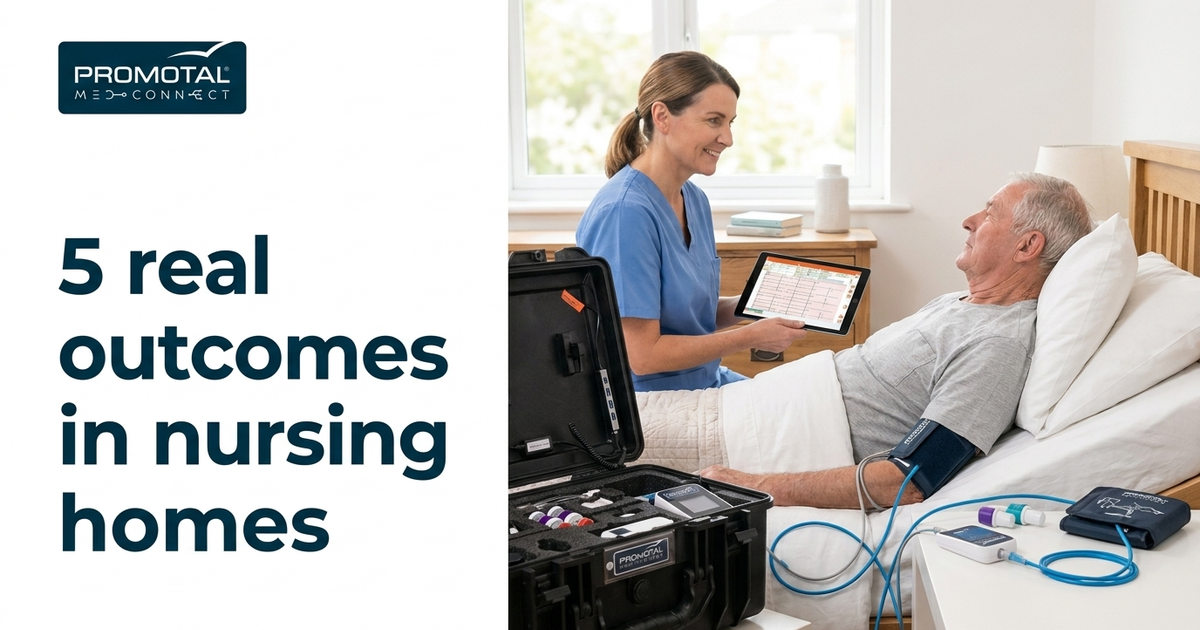
In an integrated platform, the remote doctor sees the ECG trace as it is captured. They hear the stethoscope feed live. Vital signs appear on their screen at the same moment they appear on the patient's. The 12-lead ECG uploads to the patient file in 5 seconds, with no manual entry step.
That is a different clinical environment. The doctor is present in the examination, not reviewing a report of it.
For nursing homes, where residents often present with complex, multi-system conditions, this level of data access is what makes remote consultation clinically defensible. Decisions made with live data are better decisions — and because they are documented automatically, they hold up under audit.
Outcome 5: Compliance Risk Reduced Across Multi-Site Operations
Nursing home operators managing five or more sites face a compliance problem that compounds with scale. Each site may handle patient data differently. Documentation standards vary. Audit readiness is inconsistent. When a regulator requests records, assembling them is slow and error-prone.
A single platform covering all sites, enforcing consistent documentation standards, and storing data in a certified, encrypted environment removes most of that variability.
ISO 27001:2022 certification, HIPAA compliance, and GDPR compliance are not checkboxes. They are the difference between passing an audit and explaining a gap. For French nursing homes operating under HDS-grade data requirements, data residency is equally critical — patient data must stay in Europe. A platform with EU data center options and on-premise deployment capability gives operators direct control over where that data lives.
Facilities that have standardized on a single compliant platform report faster audit responses, fewer documentation discrepancies across sites, and reduced exposure when staff turnover creates gaps in institutional knowledge.
What These Outcomes Require From the Platform
None of the five outcomes above happen with a video call tool. They require a platform designed for clinical operations from the ground up.
That means:
- Device integration that is native, not bolted on. ECG, stethoscope, vitals, and ultrasound need to stream to the remote doctor and auto-populate the patient file without manual steps.
- AI documentation that runs during the consultation. Not a transcription tool you open afterward — a scribe that generates a structured SOAP note in real time, in the clinician's language.
- A tele-expertise module inside the same platform. Specialist referral that requires switching to a separate tool adds friction and breaks the clinical record chain.
- Compliance infrastructure that covers every site. One certification that applies across the operation, not a site-by-site patchwork.
- Deployment speed that matches operational timelines. A platform that takes six months to go live is not useful to a facility under a ministry mandate or responding to a failed audit.
Promotal MedConnect is built for exactly this environment. The platform connects ECG machines, digital stethoscopes, vital signs monitors, and other devices from Welch Allyn, Schiller, MIR, Riester, Cardioline, and EDAN Instruments directly into the patient file. Elara, the AI clinical assistant, handles scheduling and drug queries by natural language. SOAP notes are written while you consult. Deployment runs 2 to 4 weeks, on cloud or on-premise.
For nursing homes specifically, the nursing homes solution page covers the deployment model and clinical workflow in detail.
FAQs
What telehealth outcomes should nursing homes prioritize when evaluating platforms? The most clinically significant outcomes are reduced unnecessary emergency transfers, improved specialist access, and faster post-consultation documentation. All three depend on whether the platform integrates medical devices and AI documentation — not just video.
Does telehealth in nursing homes require patient-side hardware training? It depends on the platform. Some require residents or families to operate devices themselves. Platforms designed for nursing home deployment put device operation in the hands of trained nursing staff, which removes the patient training requirement entirely.
How does AI documentation work during a nursing home teleconsultation? An AI medical scribe transcribes the consultation in real time and generates a structured SOAP note automatically. The note is in the patient record when the session ends — no separate documentation step required. MedConnect generates SOAP notes in French, English, Arabic, and Italian.
What compliance certifications matter for nursing home telehealth in 2026? In France and the EU, GDPR compliance and HDS-grade data residency are the baseline. ISO 27001:2022 certification covers information security management. HIPAA compliance matters for any platform with US data center options or US-based operations. All of these should apply to every site in a multi-site deployment, not just the primary location.
Can a telehealth platform reduce emergency transfers from nursing homes? Evidence from 2026 deployments points to yes — when the platform gives the remote doctor live clinical data. A doctor who can see a live ECG trace and hear auscultation in real time makes a more informed decision than one working from a verbal summary. That directly affects the transfer decision.
How long does it take to deploy a telehealth platform in a nursing home? It varies significantly by platform. Video-only tools can go live in days but offer limited clinical value. Full-stack platforms with device integration, AI documentation, and on-premise options typically deploy in 2 to 4 weeks when the vendor manages the configuration.
What hardware configurations work best for nursing home telehealth? A fixed cart suits dedicated consultation rooms in larger facilities. A medical kit works where consultations happen in resident rooms. The key requirement is that all configurations connect to the same platform and the same patient record — so clinical data stays consistent regardless of where the consultation takes place.
The Decision That Matters Now
Nursing homes that deployed integrated telehealth in 2026 are not reporting marginal improvements. They are reporting structural changes to how clinical decisions get made, how specialists are accessed, and how documentation gets done.
The gap between a video call and a real clinical consultation is measurable. It shows up in transfer rates, documentation hours, audit outcomes, and specialist engagement.
If your facility is evaluating platforms, the right question is not whether to do telehealth. It is whether the platform you choose can actually support a clinical consultation. Learn more at promotal-medconnect.com.
Ready to discover MedConnect?
Request a personalized demo and see how the platform adapts to your practice.
Request a demo