Telehealth Kit vs. Telehealth Cart vs. Backpack: Which Configuration Does Your Team Actually Need?
You've decided to deploy a telehealth solution. The clinical case is clear. The budget is approved. Now comes the question most vendor websites answer badly: which hardware configuration actually fits your care environment?
The wrong choice doesn't just create friction. It creates abandoned equipment, workarounds, and a team that's back to phone calls within three months. This article walks through the three main telehealth hardware configurations, the clinical and operational scenarios each one serves, and the questions worth asking before you commit.
The Three Configurations, Defined
Before comparing them, it helps to understand what each form factor is actually built to do. On the Promotal MedConnect platform, all three configurations connect to the same software environment. The difference is physical, not clinical.
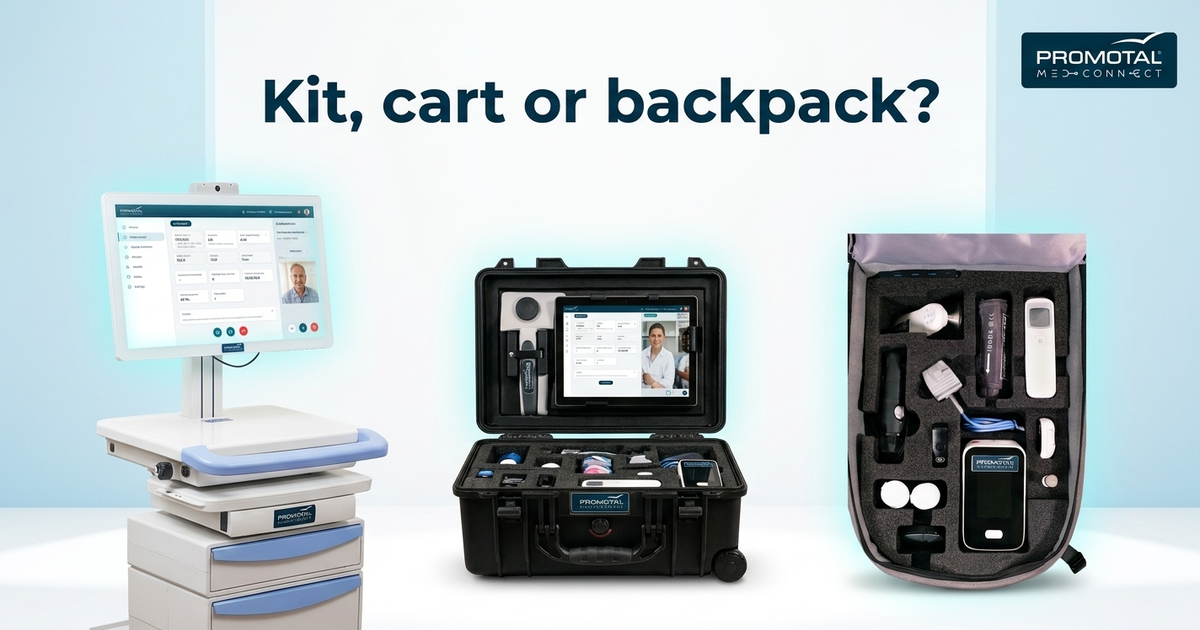
Telehealth Kit (Medical Case)
A telehealth kit is a portable, self-contained case holding the diagnostic devices a nurse or clinician needs to run a full remote consultation. That typically means a 12-lead ECG machine, a digital stethoscope, vital signs monitors, and depending on clinical scope, an otoscope or dermatoscope.
The kit is built for settings where a dedicated room doesn't exist, or where the clinician moves between patients. Home visits, mobile health units, satellite clinics, a nurse doing rounds across a care facility — the kit goes where the patient is.
Weight is the defining constraint. A well-designed kit stays under 10 kg fully loaded so a nurse can carry it between appointments without strain.
Telehealth Cart
A telehealth cart is a fixed or semi-fixed workstation on wheels. It holds the same diagnostic devices as a kit, but adds a larger display, a better camera, and a more stable power setup. The cart lives in a consultation room or a dedicated telehealth bay.
Carts are built for high-volume, structured use. A nursing home running daily specialist teleconsultations, a CPTS shared care facility handling 15 to 20 remote consultations per week, a hospital outpatient department with a dedicated teleconsultation slot — all of these benefit from a cart. The clinician comes to the equipment, not the other way around.
The trade-off is mobility. A cart moves within a building. It doesn't go on house calls.
Telehealth Backpack
The backpack is the most mobile option. It carries core diagnostic devices in a wearable form factor built for field conditions: rural terrain, remote island deployments, emergency response contexts where even a handled case is too cumbersome.
The backpack is the right choice when your team operates in genuinely austere environments. It has been deployed in remote island programs and large-scale field health operations. It is not the right choice for a structured care facility where a cart would do the same job with more stability and a better user experience.
Matching Configuration to Care Context
The configuration question is really a workflow question. Where does the consultation happen? Who carries the equipment? How many consultations happen per day?
Primary Care Networks and CPTS Facilities
If you're equipping a shared care facility under the 2026 to 2028 government feuille de route, the cart is almost always the right anchor configuration. You have a dedicated space. You want a stable, repeatable consultation workflow. Nurses and doctors know exactly where the equipment is and how to set up.
A telehealth kit makes sense as a complement if your nurses also conduct home visits or travel between satellite sites. The two configurations work together: the cart handles structured consultation volume, the kit handles the mobile caseload.
Nursing Homes and EHPADs
For an EHPAD running daily specialist teleconsultations, the cart is the primary configuration. Residents don't travel to another building for a consultation. The cart rolls to the resident's room or to a dedicated consultation space on the floor.
The key operational requirement is that the cart integrates into the clinical workflow without adding steps. On MedConnect, the 12-lead ECG auto-uploads to the patient record in 5 seconds. The remote specialist sees the ECG during the consultation, not after it. That's the standard a cart deployment in an EHPAD should meet.
Home Visit and Mobile Nursing Programs
If your nurses conduct home visits independently, the telehealth kit is the right configuration. It's portable enough to carry on public transport or in a small vehicle, and it contains everything needed for a full diagnostic consultation — connecting to the same platform the remote doctor is already using.
The critical difference between a telehealth kit and a bag of disconnected devices is software integration. A kit that streams live ECG and stethoscope audio directly to the remote doctor during the video consultation is a clinical tool. A kit that requires manual data entry and a separate file upload is an administrative burden.
Rural and Remote Field Deployments
For genuinely remote deployments, the backpack is the answer. Mobile health programs in areas without reliable road access, humanitarian response operations, field health programs where clinicians cover wide geographic areas on foot or by motorcycle — these are backpack scenarios.
The backpack doesn't sacrifice clinical capability for portability. It connects to the same platform, supports the same device integrations, and generates the same AI SOAP notes as the cart or kit. The form factor changes. The clinical standard doesn't.
The Questions That Determine Your Configuration
Before specifying hardware, answer these four questions honestly.
Does the patient come to the equipment, or does the equipment go to the patient? If patients come to a fixed location, use a cart. If clinicians travel to patients, use a kit or backpack.
How many consultations happen per day at each site? High-volume structured sites benefit from the ergonomics and stability of a cart. Lower-volume mobile use cases are better served by a kit.
What is the physical environment? A consultation room in a care facility is different from a rural health post with no mains power. The backpack is designed for the latter. The cart is not.
Do you need one configuration or a combination? Many networks deploy carts at anchor sites and kits for mobile nurses. Both connect to the same platform, so the patient record follows the patient regardless of which device was used for the examination.
What All Three Configurations Share
The hardware form factor matters less than what the hardware connects to. All three MedConnect configurations integrate with the same clinical platform: video consultation, patient records, AI documentation, billing, and specialist referral — one screen, start to finish.
A 12-lead ECG taken with a kit in a patient's home uploads to the same patient record the cart at the CPTS facility uses. The remote cardiologist accessing the tele-expertise module sees the same data regardless of which configuration captured it. The AI scribe generates the SOAP note in French, English, Arabic, or Italian whether the consultation happened in a fixed room or a field clinic.
That consistency is what makes multi-site deployment manageable. You're not maintaining three different workflows. You're maintaining one.
A Note on Compliance Across Configurations
Hardware configuration doesn't change your compliance obligations. Patient data captured by any of the three configurations is subject to the same GDPR, HIPAA, and ISO 27001:2022 requirements. MedConnect applies TLS 1.3 and AES-256 encryption across all configurations, with data center options in the US, EU, and Middle East to meet data sovereignty requirements.
If your deployment is in France and you're subject to HDS certification requirements, confirm that your platform vendor meets that standard regardless of which hardware configuration you select. The configuration is the delivery mechanism. The platform is where compliance is enforced.
Summary: Configuration Decision at a Glance
| Scenario | Recommended Configuration |
|---|---|
| Fixed consultation room, high volume | Cart |
| Nurse-led home visits | Kit |
| Mobile clinics, satellite sites | Kit |
| Rural or remote field deployment | Backpack |
| Multi-site network with mixed use | Cart + Kit combination |
| Emergency or humanitarian response | Backpack |
The right configuration is the one your team will actually use. A cart sitting in a corridor because no one was trained to move it is not a telehealth deployment. A kit that takes 20 minutes to set up before each consultation will be abandoned within a month.
Specify based on workflow, not on what looks most impressive in a procurement document.
To see how each configuration fits your specific care environment, visit promotal-medconnect.com and request a demo. The team can walk through your site setup and recommend the right hardware and deployment model before you commit.
Frequently Asked Questions
What is a telehealth kit and how does it differ from a telehealth cart? A telehealth kit is a portable case containing diagnostic devices designed for mobile use — home visits, satellite clinics, nurse-led rounds. A telehealth cart is a fixed or semi-fixed workstation designed for high-volume consultations in a dedicated room. Both connect to the same clinical platform and support the same diagnostic integrations.
Which telehealth configuration is best for a nursing home or EHPAD? A telehealth cart is the standard configuration for nursing homes. It rolls to the resident's room or a dedicated consultation space and supports high-frequency specialist teleconsultations. The cart provides a stable, repeatable setup that fits structured daily workflows.
Can a telehealth kit perform a 12-lead ECG? Yes. A properly integrated telehealth kit includes a 12-lead ECG machine that connects directly to the clinical platform. On MedConnect, the ECG auto-uploads to the patient record in 5 seconds with no manual data entry, and the remote doctor sees the results during the live consultation.
When should a team choose a telehealth backpack over a kit? The backpack is designed for genuinely austere or remote environments where a portable case is still too cumbersome — rural field programs, remote island deployments, humanitarian response operations. For standard home visits or mobile nursing, a telehealth kit is the more practical choice.
Can different hardware configurations work together on the same platform? Yes. On MedConnect, all three configurations connect to the same platform. A patient examined with a kit at home and then seen at a cart-equipped facility has one continuous patient record. The clinical data is consistent regardless of which configuration captured it.
Do compliance requirements change based on the hardware configuration used? No. GDPR, HIPAA, and ISO 27001:2022 requirements apply to all configurations equally. Compliance is enforced at the platform level, not the hardware level. Confirm that your platform vendor meets the applicable standards before specifying any hardware configuration.
How long does it take to deploy a telehealth kit or cart configuration? MedConnect deploys in 2 to 4 weeks for both cloud SaaS and on-premise environments, regardless of which hardware configuration you select. That timeline covers platform setup, device integration, and clinical staff onboarding.
Ready to discover MedConnect?
Request a personalized demo and see how the platform adapts to your practice.
Request a demo