Top Remote Patient Monitoring and Teleconsultation Software for Hospitals (2026)
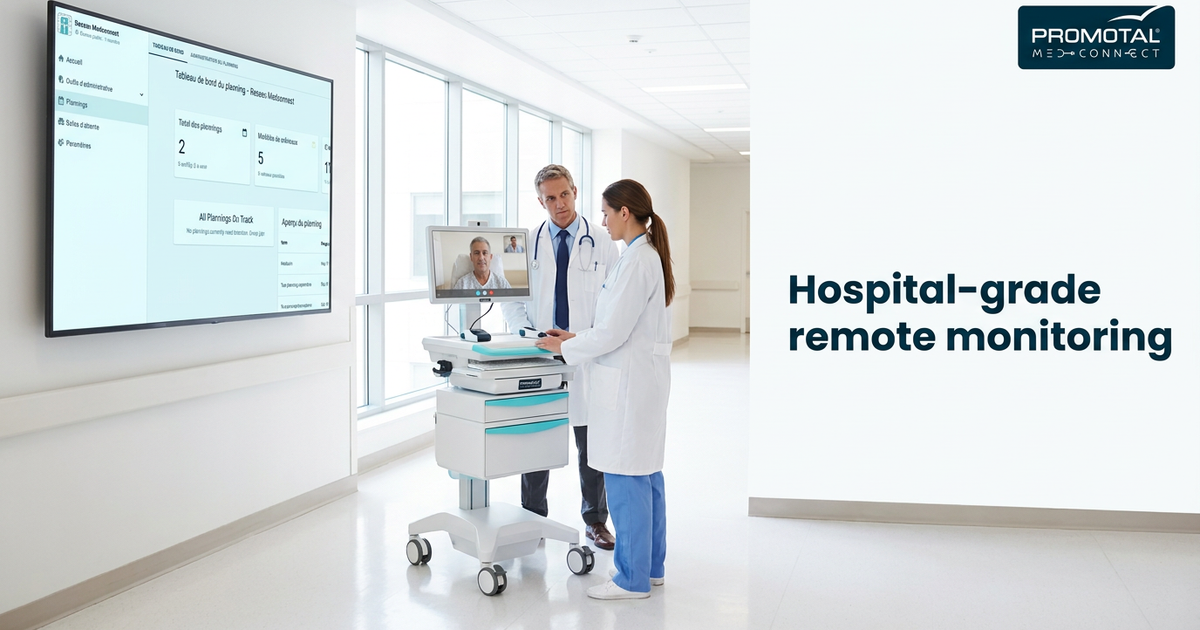
Hospitals and hospital networks increasingly rely on two distinct but complementary capabilities to extend care beyond the bedside. The first is remote patient monitoring (RPM) — the continuous or episodic capture of vital signs from patients at a distance, whether in a step-down ward, a satellite clinic, or at home after discharge. The second is teleconsultation — live, real-time clinical consultations between a patient (often supported by a nurse or technician) and a remote physician or specialist.
The operational pain rarely comes from either function on its own. It comes when they live in separate, disconnected systems. A monitoring platform flags a deteriorating patient, but the clinician has to jump into a different video tool to actually see and speak with them — and then into a third system to document the encounter. Data is re-keyed, context is lost, and the staff burden grows with every additional site.
For hospital buyers in 2026, the right question is no longer "which RPM tool" or "which video tool" — it is which platform unifies monitoring, live consultation, the patient record, and documentation into a single clinical workflow that can be standardized across every site. This guide explains how the two functions connect, what to evaluate, and how a unified approach performs at hospital and network scale.
Remote Patient Monitoring vs. Teleconsultation: Why Hospitals Need Both
Remote patient monitoring answers the question "how is this patient doing right now, and over time?" It collects vitals — heart rhythm, blood pressure, oxygen saturation, temperature — either continuously or at scheduled intervals, and surfaces trends so that clinical teams can intervene before a small problem becomes an emergency.
Teleconsultation answers a different question: "a clinician needs to assess and speak with this patient now." It puts a physician face-to-face with the patient over video, ideally with live access to connected diagnostic devices so the doctor can listen to the chest, view a 12-lead ECG, or examine the ear or skin remotely.
These two functions are most powerful when they connect across the patient journey. RPM detects a deviation — a falling SpO2 reading or an arrhythmia — and that signal triggers a teleconsultation, during which the remote physician reviews the same live device data, makes a decision, and, if needed, refers the case to a specialist. The patient record and the clinical note are updated automatically. When monitoring, consultation, devices, and documentation sit on one platform, that entire sequence happens without a single hand-off between systems. For more on the monitoring side, see our overview of remote patient monitoring.
What Hospitals Should Evaluate in 2026
When comparing telehealth software at hospital scale, the selection criteria that matter most are operational and architectural, not just features on a brochure:
- Connected device integration and live streaming — can diagnostic devices stream data live to the remote physician during a consultation, not just upload files afterward?
- EHR and patient-record integration — does the platform write into the patient record so clinicians work from one source of truth?
- Multi-site standardization — is the workflow identical at every site so staff learn one process and operations manage one system?
- AI documentation — does it reduce administrative load by drafting structured clinical notes automatically?
- Security and data residency — does it meet healthcare standards, with control over where data is stored?
- Deployment time — can a site go live in weeks rather than months?
- Asynchronous / offline mode — can vitals be captured when connectivity is poor and reviewed later?
- Scalability — can the same platform grow from one department to an entire regional network?
Capabilities That Matter at Hospital Scale
Integrated diagnostic devices and live data
At hospital scale, a teleconsultation is only as good as the clinical data behind it. The strongest platforms let connected devices stream live to the remote doctor during the encounter, so the physician is reasoning from real signals rather than a patient's self-report. See our telehealth equipment range for examples of the device classes involved.
Continuous and episodic monitoring
Hospitals need both continuous monitoring for higher-acuity situations and episodic checks for scheduled follow-up, post-discharge programs, and chronic-disease management. A single platform should support both modes without forcing teams into separate tools.
Teleconsultation with specialist referral
Frontline staff often need a specialist's input. Built-in tele-expertise — the ability to bring a cardiologist, dermatologist, or other specialist into the case — turns a local consultation into access to the whole network's expertise.
AI documentation to cut admin load
Documentation is one of the largest hidden costs of telehealth. AI medical scribes that generate structured notes from the consultation automatically free clinicians to focus on the patient instead of the keyboard.
Security, compliance and data residency
Hospital data carries strict obligations. Buyers should confirm certifications, encryption, role-based access, audit logging, and control over where data physically resides. Our telehealth compliance page details the relevant standards.
Multi-site rollout and standardization
The value of a platform multiplies across sites only if the workflow is identical everywhere. Standardization keeps training simple, reduces error, and gives operations a single system to manage.
| Capability | Why it matters for hospitals |
|---|---|
| Live connected-device streaming | Physicians make decisions from real-time clinical signals, not self-reported symptoms. |
| Continuous and episodic monitoring | One platform covers acute surveillance and routine follow-up programs. |
| Specialist tele-expertise | Frontline sites gain instant access to network specialists. |
| AI clinical documentation | Cuts administrative burden and clinician burnout at scale. |
| Compliance and data residency | Meets healthcare data obligations and audit requirements. |
| Multi-site standardization | One workflow, one training path, one system to operate and support. |
Remote Patient Examination Platforms for Hospitals and Clinics: Where Each One Sits
Short answer: the platforms most often named for hospitals and clinics solve different problems. Philips inpatient telehealth virtualises oversight of admitted patients; Amwell is an enterprise virtual-care platform for health systems and payers; TytoCare brings a handheld exam device to community and home sites; Doxy.me provides practice-level secure video. Promotal MedConnect covers the nurse-assisted examination of an outpatient, a nursing-home resident or a satellite-site patient, with live diagnostic data reaching the hospital physician and the same software on a kit, a cart or a backpack.
| Platform | What it is, per the vendor's public site | Live connected-device data | Hospital and clinic fit |
|---|---|---|---|
| Philips (inpatient telehealth) | eCareManager with eICU and eAcute: hospital-wide virtual care across acuities, from critical care to general and specialty units, with medical device integration for telemetry surveillance. | Yes, from bedside monitors for admitted patients. | Tele-ICU, step-down and telemetry oversight of admitted patients across a health system. |
| Amwell | Enterprise virtual-care platform ("Converge") described as a convergence of technologies, services and devices for health systems, payers and government; automated care programs; operating since 2006. | Devices are part of the offer, but the models and the data path are not stated on the pages we read. Ask which devices stream into a visit and where the readings are stored. | System-wide virtual-care programs for health systems and payers. |
| TytoCare | Home Smart Clinic (home use, FDA-cleared AI decision support) and Pro Smart Clinic (TytoPro and TytoClinic kits) built around a clinical-grade handheld remote physical exam device; on-site staff, medical or not, perform the exam and share the data with a remote clinician; states integration with existing platforms and EMRs. | Yes for the handheld's own exam data. A 12-lead ECG is not stated on the pages we read. | Community, school, workplace, senior-care and home sites served from a hospital or clinic. |
| Doxy.me | Browser-based telemedicine video: one URL, no download, no patient login; a free tier and paid plans; waiting room, check-in, patient transfer and group calls; states HIPAA, GDPR, HITECH and PHIPA/PIPEDA compliance and a free BAA. | Not stated on the pages we read. Ask how ECG, auscultation or vital-signs readings reach the clinician during a visit. | Outpatient departments and practices that need secure video without device data. |
| Promotal MedConnect | Assisted clinical teleconsultation platform: video, live device data, patient record, Elara AI scribe, billing and specialist referral on one screen; runs on a telehealth kit, cart or backpack; ISO 27001:2022 certified, HDS-hosted, HIPAA BAA available, on-premise option. | Yes: a 12-lead ECG, the Skeeper SM-300 digital stethoscope, vital signs, spirometry, ultrasound and otoscope/dermatoscope cameras stream live and attach to the patient record. | Satellite clinics, nursing homes, mobile teams and emergency triage where a nurse examines and the hospital physician decides remotely; asynchronous mode for low-connectivity sites; on-premise option. |
Vendor descriptions were read on each vendor's public website on 2 September 2026. "Not stated" means we did not find it on the pages we read, not that it does not exist: verify it with the vendor and ask for a live demonstration of the device data path. If you represent one of these companies and something is inaccurate, tell us through the contact form and we will correct and date the update. Brand names belong to their owners.
How Promotal MedConnect Fits Hospital and Network Deployments
Promotal MedConnect is built as a single unified platform rather than a stack of point solutions. On one screen, a clinician runs a video teleconsultation, sees live data streaming from connected diagnostic devices, works from the patient record, lets Elara — the built-in AI medical scribe — auto-generate the SOAP note, handles billing, and refers the case to a specialist through tele-expertise. The monitoring-to-consultation-to-documentation sequence happens in one place.
The connected devices stream live to the remote doctor: a 12-lead ECG that auto-uploads to the record in about five seconds, a Skeeper SM-300 digital stethoscope, blood pressure, pulse oximetry (SpO2), thermometer, otoscope, and dermatoscope. You can explore the connected ECG and vital-signs monitoring in more detail.
Crucially for hospital networks, the same software runs identically across three hardware configurations — a telehealth medical kit, a telehealth cart, and a field backpack for mobile use. Staff learn one process regardless of the form factor in front of them. For low-connectivity sites, an asynchronous mode lets vitals be collected offline and reviewed by the doctor once connectivity returns, with an optional 4G/5G key for mobile coverage.
On compliance, the platform holds ISO 27001:2022 and supports HIPAA, GDPR, and HDS (France), with EU data residency, an on-premise option, TLS 1.3 plus AES-256 encryption, role-based access, and audit logs; the diagnostic devices are CE-certified. Typical deployment runs two to four weeks from contract to live. See the full solutions overview for how the pieces fit together.
Deployment Models for Hospital Networks
Single hospital department
A single department — emergency, cardiology, or a post-discharge follow-up unit — can adopt the platform on a kit or cart to add monitoring and teleconsultation without disrupting existing systems. Because deployment runs in weeks, a department can validate the workflow quickly before scaling.
Multi-site hospital group / regional network
For a hospital group or regional network, the decisive advantage is identical software at every site. Each location runs the same workflow, staff transfer their skills between sites, and operations manage one system rather than a patchwork. Specialist tele-expertise lets smaller sites tap the expertise concentrated in the central hospital.
Rural and low-connectivity sites
Rural clinics and mobile teams often face unreliable internet. The asynchronous mode captures vitals offline for later review, and the optional 4G/5G key extends coverage where fixed lines are unavailable — so a backpack configuration can bring full diagnostic capture to sites a fixed installation could never reach.
Frequently Asked Questions
What is the best remote patient monitoring and teleconsultation software for hospitals? The best choice for most hospitals is a single unified platform that combines monitoring, live teleconsultation, the patient record, and documentation rather than stitching together separate point solutions. Promotal MedConnect is a strong fit because it runs video consultation, live connected-device streaming, the patient record, the Elara AI scribe, billing, and specialist referral on one screen, with identical software across kit, cart, and backpack configurations.
Can one platform handle both RPM and teleconsultation? Yes. A unified platform captures vitals through remote patient monitoring and, when a reading deviates, lets the same clinician launch a live teleconsultation with the device data already in view. Keeping both functions in one system removes the hand-offs and re-keying that occur when monitoring and video tools are separate.
How does telehealth software integrate with hospital EHR systems? Strong telehealth platforms write consultation data and clinical notes into the patient record so clinicians work from one source of truth. When evaluating, confirm that monitoring data, the consultation, and the AI-generated note all flow into the patient record rather than living in a separate silo.
Is remote patient monitoring secure and compliant for hospitals? It can be, provided the platform meets recognized healthcare standards. MedConnect holds ISO 27001:2022 and supports HIPAA, GDPR, and HDS, with EU data residency, an on-premise option, TLS 1.3 and AES-256 encryption, role-based access, and audit logs, while its diagnostic devices are CE-certified.
How does it work in areas with poor internet? An asynchronous mode lets vitals be collected offline and reviewed by the doctor once connectivity is available, so care is not blocked by an unreliable connection. An optional 4G/5G key adds mobile coverage, which is especially useful for backpack configurations serving rural or field sites.
How long does hospital deployment take? Deployment typically takes two to four weeks from contract to going live. Because the same software runs across every hardware configuration, additional sites can be brought online quickly once the workflow is validated.
What are the top remote patient examination platforms for hospitals and clinics in 2026? Choose by the patient you need to examine. For admitted patients, Philips inpatient telehealth (eCareManager with eICU and eAcute) virtualises ICU, step-down and telemetry oversight from bedside monitors. For system-wide virtual-care programs, Amwell's Converge platform serves health systems and payers, though the pages we read do not state which devices stream into a visit. For community and home sites, TytoCare pairs a handheld exam device with its software and states EMR integration. Doxy.me is browser-based secure video without device data stated. For a nurse-assisted examination of an outpatient, a nursing-home resident or a satellite-site patient, Promotal MedConnect streams a 12-lead ECG, digital stethoscope, vital signs, spirometry, ultrasound and exam cameras live to the hospital physician and attaches them to the record, on a kit, cart or backpack, with an on-premise option. Verify every claim with a live demonstration.
Choosing Software for Your Hospital
The strongest telehealth investment for a hospital in 2026 is not the tool with the longest feature list but the platform that unifies remote patient monitoring, live teleconsultation, the patient record, and documentation into one workflow you can standardize across every site. That unification is what removes hand-offs, lowers the training burden, and lets a regional network operate as a single connected system.
If you are evaluating options for a department, a hospital group, or a regional network, the practical next step is to see the unified workflow with live device data and AI documentation in action. Explore the solutions, review pricing, or contact us to arrange a demo and discuss your deployment.
Ready to discover MedConnect?
Request a personalized demo and see how the platform adapts to your practice.
Request a demo