Home Telehealth Kits vs Clinical Telehealth Kits: Which One Does Your Organisation Need?
If you search "telehealth kit" to equip a healthcare organisation, the results mix two categories of product that have almost nothing in common: consumer kits sold to households for a few hundred dollars, and clinical systems built so a remote physician can conduct an examination. Both are called "kits". They do not solve the same problem, and the SERP will not tell you which one you are looking at.
The difference in one sentence
A consumer kit lets a patient collect a few readings and send them. A clinical kit lets a health professional perform an examination while a remote physician directs and interprets it live.
What a consumer kit contains
As a public, verifiable example: Nonagon Care states on its site (checked 17 August 2026) a Care Kit at $239.99, a ConnectCare membership at $7.99/month, and virtual visits at $39 (adult) or $49 (paediatric). The kit includes an oximeter, thermometer, stethoscope and otoscope, and is marketed to families including while travelling, for ages 3-17 and adults. The site states "FDA-cleared"; ISO and CE marking are not mentioned.
That is a good product for what it is. It is not institutional equipment: no ECG, no integration with the organisation's patient record, no service commitment, no fleet management.
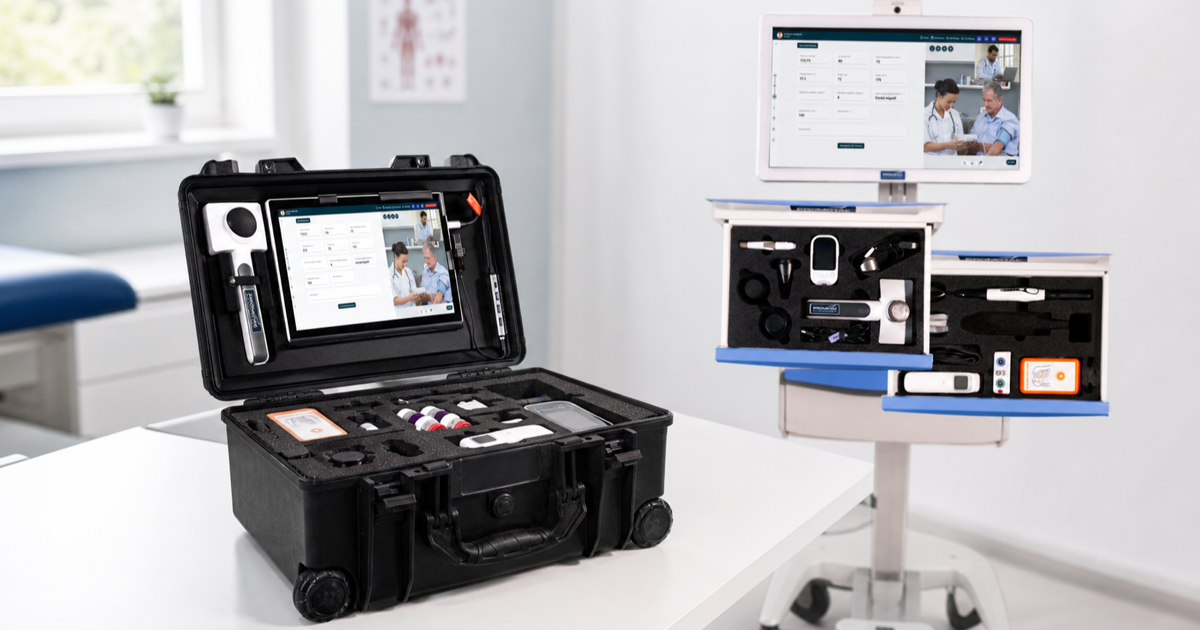
What a clinical kit has to contain
- Devices that produce a billable clinical act — 12-lead ECG, digital auscultation streamed live, full vitals, imaging (dermatoscope, otoscope), and depending on need a spirometer, analyser or ultrasound.
- Real-time transmission to the remote physician, not a later upload of photos and values.
- Automatic writing to the patient record, with no re-keying or manual export.
- A compliance posture you can put in front of a regulator — health-data hosting, documented encryption, access logging.
- A service contract: training, support, maintenance, replacement, and a vendor accountable for uptime.
- Fleet management once more than one site is equipped.
How to avoid buying the wrong category
Ask one question: who makes the diagnosis, and on what data? If the answer is "the patient sends readings and a clinician reviews them later", a consumer kit may be enough. If the answer is "a nurse examines the patient and a physician decides during the consultation", you need a clinical system — and price, certification and service terms all change accordingly.
At Promotal MedConnect the telehealth kit sits firmly in the second category: 12-lead ECG auto-uploading to the record in about five seconds, live digital stethoscope, ISO 27001:2022, HIPAA with a BAA available, GDPR, HDS hosting, and two-to-four-week deployment. If compliance is the deciding factor, the HIPAA platform evaluation guide sets out what to verify with any vendor.
Frequently asked questions
Can a consumer kit be used in a clinic? For occasional, non-diagnostic use, possibly. But it does not integrate with the organisation's patient record, does not provide an ECG, and carries no service contract — three issues that become blocking as soon as a reimbursed act or a multi-site rollout is involved.
Why do prices range from $240 to several thousand? Because these are not the same products. A consumer kit is four sensors and an app. A clinical system adds CE-marked medical devices, a platform, record integration, compliance and support.
Does a kit need an ECG? It depends on the clinical act. Without one, assisted teleconsultation is limited on the cardiovascular side. Verify this explicitly: several kits, consumer and professional alike, do not mention an ECG.
How do I check a compliance claim? Ask for the document. ISO 27001 is third-party audited and verifiable; "HIPAA certified" does not exist; "FDA-cleared" applies to a specific device, not to a whole platform. Always ask which exact product a claim covers.
Information attributed to a third-party vendor comes only from that vendor's public website, checked 17 August 2026. "Not mentioned" means absent from the page we read, not non-existent. Brand names remain the property of their owners. Something inaccurate? Contact us or write to [email protected] and we will correct it and date the update.
Adding oral-health screening? A configurable kit can include an FHD intraoral dental camera alongside the MedConnect platform. See the complete teledentistry platform workflow for live and asynchronous dentist review.
US care organizations: see the clinician-assisted remote exam kit for home health and telehealth for rural health clinics and FQHCs.
Ready to discover MedConnect?
Request a personalized demo and see how the platform adapts to your practice.
Request a demo