What Equipment Do You Need for Telemedicine? Complete Guide 2026
What equipment do you need to practice telemedicine?
Whether you're equipping a clinic, nursing home, primary care network, or mobile healthcare unit, the right telemedicine equipment depends on your clinical environment, the type of consultations you perform, and your mobility requirements. This guide covers everything from the minimum setup to a fully equipped telehealth station.
The basics: simple video teleconsultation
For a standard video consultation (doctor alone with a remote patient), the equipment requirements are relatively simple:
- A computer, tablet, or smartphone with a good quality camera and microphone
- A stable internet connection (minimum 2 Mbps upload and download)
- A certified teleconsultation software that meets healthcare data hosting requirements
This is sufficient for follow-up consultations or prescription renewals. But as soon as you need to examine the patient remotely, the equipment requirements change dramatically.
Assisted teleconsultation: connected diagnostic devices
Assisted teleconsultation involves a healthcare professional (nurse, medical assistant) present with the patient using connected diagnostic devices while the doctor observes and interprets data remotely in real time. This is where equipment makes the difference.
Essential diagnostic devices
The most commonly used connected medical devices in assisted teleconsultation:
| Device | What it measures | Specialties |
|---|---|---|
| Digital stethoscope | Heart and lung sounds | General practice, cardiology, pulmonology |
| 12-lead ECG | Heart electrical activity | Cardiology, emergency, general practice |
| Vital signs monitor | Blood pressure, SpO2, pulse, temperature | All specialties |
| Connected dermatoscope | High-definition skin images | Dermatology, general practice |
| Connected otoscope | Ear canal and eardrum imaging | ENT, pediatrics |
| Portable ultrasound | Real-time ultrasound imaging | Obstetrics, urology, emergency |
| Spirometer | Lung capacity (FEV1, FVC) | Pulmonology, occupational medicine |
| Connected glucometer | Capillary blood glucose | Diabetology, general practice |
| Bladder scanner | Bladder volume via ultrasound | Urology, geriatrics |
The critical factor: these devices must transmit their data in real time to the telehealth platform so the remote doctor can view it during the consultation. This is what distinguishes a simple medical device from a connected medical device for telemedicine.
Hardware form factors: which format for which use?
Connected diagnostic devices can be integrated into different hardware formats depending on your work environment:
The telehealth kit (portable case)
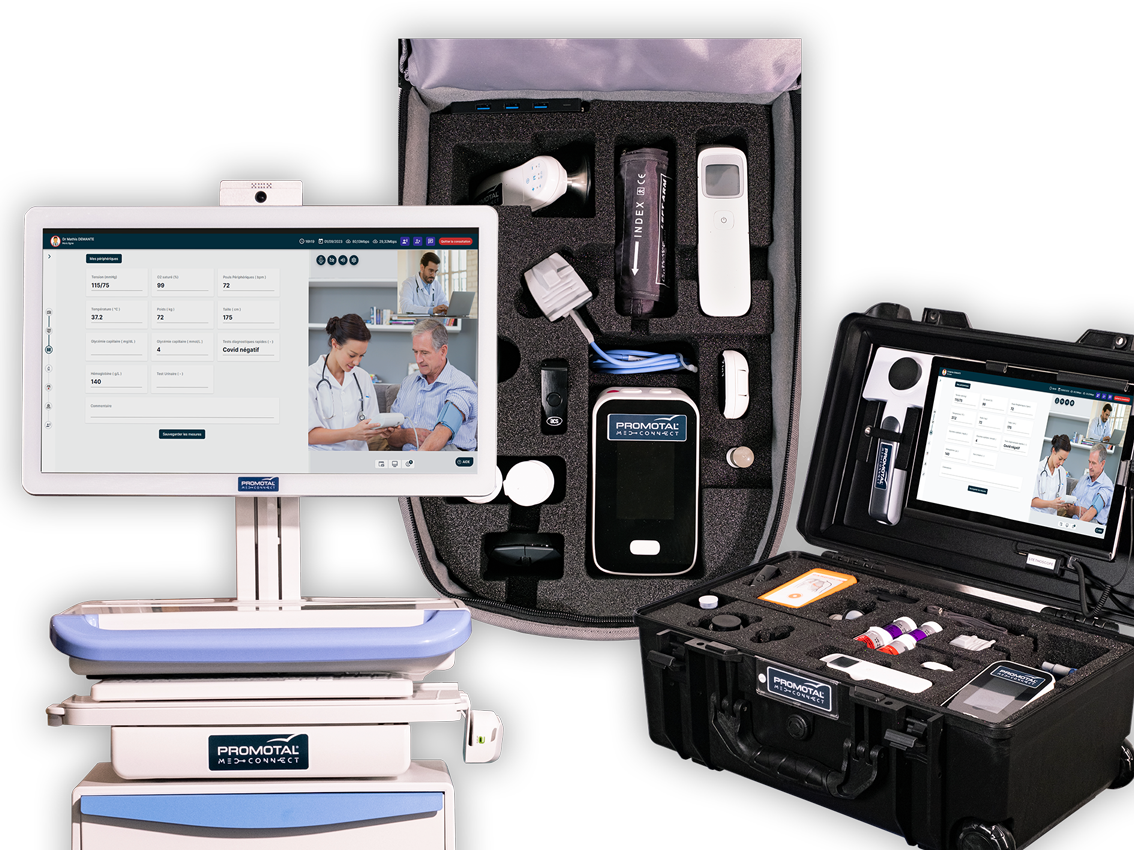
A portable format designed for home visits and mobile healthcare. Contains essential devices in a compact case that fits in a car trunk. Ideal for mobile nurses, primary care networks, and home care.
The telehealth cart
A complete rolling station for fixed healthcare facilities: nursing homes, hospitals, care centres. The telemedicine cart integrates 20+ connected devices, a high-definition screen, and a built-in battery. It rolls from room to room.
→ Discover our telehealth cart
The telehealth backpack
An ultra-mobile format for challenging environments: rural areas, remote sites, mass events. Same medical-grade devices, compact format that keeps your hands free.
→ Discover our telehealth backpack
The software platform: the brain of the system
Hardware doesn't work alone. Every device must connect to a telehealth software platform that provides:
- Video consultation between the patient (and assisting nurse) and the remote doctor
- Real-time reception of device data (ECG curves, auscultation, dermatoscopic images, etc.)
- Patient records with consultation and measurement history
- Billing integration where applicable
- Regulatory compliance (healthcare data hosting, GDPR, ISO 27001, HIPAA)
→ Discover our software platform
How much does telemedicine equipment cost?
The cost varies by format and number of devices:
- Entry configuration (backpack + essential devices + software platform): from €3,000 ex-VAT
- Complete kit with all CE-certified instruments and integrated platform: higher investment
- Complete cart with 20+ devices and HD screen: quote on request
Most public health and international deployments qualify for grant coverage or volume pricing. Contact us for a deployment assessment.
How to choose? The essential criteria
Before investing in telemedicine equipment, ask yourself:
- What type of consultations will you perform? Simple video consultation, assisted teleconsultation, or tele-expertise? This determines which devices you need.
- What is your environment? Fixed clinic, home visits, facility with patient rooms? This determines the format (cart vs kit vs backpack).
- Are the devices connected to the platform? A digital stethoscope that doesn't stream data in real time to the remote doctor is not a telemedicine tool.
- Is the platform certified? Check healthcare data hosting compliance, GDPR, and certifications (ISO 27001, HIPAA, etc.).
- Does the manufacturer provide support and training? Telemedicine integration requires guidance, not just hardware.
Need help choosing the right telemedicine equipment? Contact our team for a free needs assessment and a quote tailored to your environment.
Next step: compare Promotal MedConnect telehealth equipment for clinical programs, including telemedicine carts, telehealth kits, connected diagnostics and secure software.
Ready to discover MedConnect?
Request a personalized demo and see how the platform adapts to your practice.
Request a demo