How to deploy a telehealth center in a rural or remote area: a practical guide
Deploying a telehealth center in a rural or remote area is not the same as adding video calls to an urban clinic. The constraints are different: unreliable connectivity, limited clinical staff, long distances to specialist care, and often little existing digital infrastructure. The approach must account for all of these realities.
This guide draws on MedConnect deployments in remote Pacific islands (New Caledonia), rural West Africa (Ivory Coast), a large pilgrimage health program in Saudi Arabia (in progress), underserved areas of France and at-home consultations in the United States. Approximately 50,000 examinations have been recorded across these environments.
Why rural telehealth is different from urban telehealth
Urban telehealth typically assumes reliable broadband, nearby specialist hospitals and patients comfortable with technology. Rural telehealth can assume none of these:
- Connectivity: bandwidth may be intermittent, limited to 4G, or unavailable at certain hours. Satellite internet adds latency. A platform that only works on stable broadband will fail.
- Staffing: physicians are scarce—that is the reason for telehealth. The on-site team is typically nurses or community health workers, so the system must be operable by non-physician staff.
- Infrastructure: there may be no IT department, no server room and no electronic health record. The solution must be largely self-contained.
- Power: electricity can be inconsistent. Battery-powered devices and a UPS are essential, not optional.
The 4 infrastructure questions to answer first
1. What connectivity is available?
Map the options—fiber, DSL, 4G/5G, satellite—and test actual upstream bandwidth at the site at different times of day. Live (synchronous) visits need a stable connection for two video streams plus device data. Where the connection is weak or intermittent, use store-and-forward (asynchronous) visits: the nurse performs the examination, the data is recorded, and it is sent for physician review when the connection allows.
2. Is the deployment temporary or permanent?
A permanent clinic can justify a cart or fixed station with a wired network. A mobile or temporary deployment (outreach, seasonal campaigns, mobile clinics) needs a portable telemedicine kit that fits in a case or backpack and runs on battery and cellular data.
3. What is the regulatory environment?
Data-hosting requirements vary by country. Some ministries of health require health data to stay on national soil. MedConnect supports cloud hosting (AWS, with HDS-certified hosting in France and US hosting for US customers under a Business Associate Agreement) and a fully on-premise deployment, used for the Saudi Hajj project for data-sovereignty reasons.
4. What clinical scope is needed?
A primary care screening point needs vital signs, basic point-of-care tests and triage. A specialist referral hub needs ECG, ultrasound and high-resolution imaging. Define the clinical scope before selecting devices.
Live vs store-and-forward
Most remote telehealth clinic deployments use both modes:
- Synchronous (live): when bandwidth allows, the nurse and physician are connected live. The physician sees two video streams (patient and device camera), the live ECG and stethoscope audio. This is the preferred mode for complex cases.
- Asynchronous (store-and-forward): when connectivity is poor or volume is high, the nurse records the examination and the physician reviews it later. At the Dignité Sociale medical center in Ivory Coast, this model supports screening of around 150 patients per day.
The data format is the same in both modes: the physician reviews the same ECG traces, vital signs and images.
Staffing: who does what when there is no doctor on site
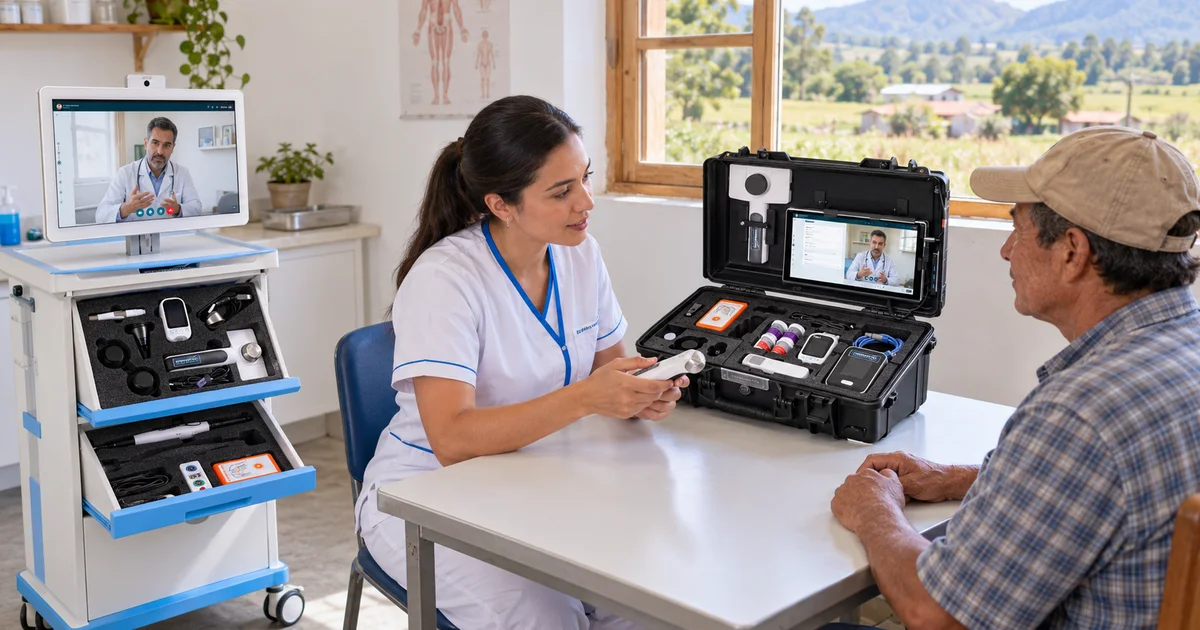
The nurse-led model is the foundation of rural telehealth. The on-site nurse (the telepresenter, in US terms) operates the devices and performs the examination; the remote physician provides the assessment and specialist opinion. A typical single-station telehealth center has one trained nurse per station, a receptionist for patient flow, and one or more remote physicians who can cover several sites. Daily capacity depends on the visit type.
Hardware: kit vs cart vs backpack
- Telemedicine kit: ECG, stethoscope, dermatoscope, otoscope and vital signs monitor in a portable case (~8 kg). For home visits, mobile clinics and temporary deployments. See the telehealth kit.
- Telemedicine cart: a fixed station with a 21.5" screen and the full device suite, including ultrasound. For permanent clinics and hospitals. See the telehealth cart.
- Telemedicine backpack: the lightest option (under 3 kg) for screening and triage. See the telehealth backpack.
The Saudi Hajj project combines fixed modular clinic units with cart setups and mobile kits for field screening teams. Our kit vs cart comparison helps choose.
MedConnect Hub (in development)
In low-resource settings a full PC is often impractical. MedConnect is developing the Hub, a compact device bridge (under 15 × 15 × 5 cm, VESA-mountable) that connects medical devices over USB and Bluetooth, provides Gigabit Ethernet and Wi-Fi, runs a hardened Linux system and receives over-the-air updates—so sites without IT staff do not have to maintain a general-purpose computer. Until it is available, devices connect through the station's tablet or computer.
Training
- Device operation: ECG electrode placement, stethoscope positioning, camera and dermatoscope use.
- Platform navigation: patient creation, consultation workflow, data review and reports.
- Clinical workflow: the full visit from patient arrival to report, practiced on simulated cases.
Training typically takes about a day and needs no prior telemedicine experience. It can be delivered remotely; the interface is available in English, French, Arabic and Italian. See also assisted teleconsultation.
Timeline: from contract to first consultation
- Week 1: platform configuration, user accounts, network checks
- Week 2: hardware assembly and configuration at Promotal's facility in Ernée, France, then shipping
- Week 3: set-up and staff training (on site or remote depending on the project; US customers are trained remotely)
- Week 4: supervised go-live with support
Typically 2 to 4 weeks from contract to first patient for a single site; multi-site rollouts scale with logistics more than configuration.
Deploying in the United States
For US rural and community providers, the same model applies with US-specific pages:
- Telehealth for rural and critical access hospitals—specialty consultations at the bedside or in an outpatient room.
- Telehealth for rural health clinics and FQHCs—nurse-presented visits that work alongside your existing EHR and billing system.
- Remote exam kit for home health—the physician examines the patient live during a nurse home visit.
- Rural Health Transformation Program telehealth guide—how state RHTP subgrants can fund telehealth equipment.
US deployments are HIPAA-ready, run under a signed Business Associate Agreement with US data hosted on AWS in the United States, and use FDA-cleared and FDA-registered connected devices. Equipment is shipped configured, with remote training and remote support.
Reference deployments
New Caledonia (Province Nord): remote island healthcare, more than 1,500 teleconsultations completed, with a full diagnostic suite including ultrasound.
Ivory Coast (Dignité Sociale medical center): BPI France-funded screening program; around 150 patients screened per day in store-and-forward mode.
Saudi Arabia (Hajj project, in progress): fixed modular clinics plus mobile field kits, on-premise hosting for data sovereignty, Arabic-language interface.
FAQ
What internet connection does a rural telehealth center need?
Live visits need a stable upstream connection for two video streams plus device data—test it at the site before deployment. Store-and-forward visits tolerate weak or intermittent connections because data is sent when the connection allows.
Can telehealth work without a live connection?
Yes, in store-and-forward mode: the nurse performs and records the examination, and the remote physician reviews it once the data has been transmitted.
What is the minimum staffing for a telehealth center?
One trained nurse per consultation station, plus one or more remote physicians who can cover several sites.
How long does staff training take?
About a day, covering device use, platform navigation and the clinical workflow. No prior telemedicine experience is needed.
What happens if equipment fails at a remote site?
Support teams diagnose issues remotely and replacement devices are shipped; coverage terms are set in your contract.
Ready to discover MedConnect?
Request a personalized demo and see how the platform adapts to your practice.
Request a demo