Best Telehealth Platforms for Clinical Consultations with Medical Device Integration (2026)
When clinicians search for the best telehealth platform, they usually find a long list of video-conferencing tools dressed up for healthcare. These products are good at connecting two faces over a screen, but a clinical consultation is not a video call. A doctor cannot listen to a patient's lungs, read a 12-lead ECG, or confirm an oxygen saturation reading through a webcam. Without live clinical data, the remote physician is left guessing rather than examining.
This is the gap that medical device integration is supposed to close. In a clinical telehealth context, integration does not mean a generic video link with a file-upload button. It means connected diagnostic devices that stream measurements directly into the consultation in real time, automatically attach those results to the patient record, and give the remote doctor the same clinical signal a colleague in the room would have. That distinction is what separates a teleconsultation that supports a real diagnosis from one that simply advises the patient to come in person.
This guide explains what to evaluate when choosing a telehealth platform for clinical consultations with medical device integration in 2025 and 2026, compares generic video tools against integrated clinical platforms, and describes how Promotal MedConnect approaches clinical-grade telemedicine.
What Makes a Telehealth Platform Suitable for Clinical Consultations
A platform built for clinical work has to do far more than carry audio and video. When evaluating options, buyers should weigh the following criteria:
- Live diagnostic device streaming — can connected devices send measurements to the remote doctor in real time, not after the fact?
- Automatic upload to the patient record — do results attach to the patient's file without manual re-entry or screenshots?
- Breadth of integrated devices — does it support the full set a clinical exam requires: ECG, stethoscope, blood pressure, SpO2, temperature, otoscope, dermatoscope?
- AI-assisted documentation — does the platform help generate structured clinical notes so the clinician can focus on the patient?
- Compliance and data residency — does it meet healthcare data standards (ISO 27001, HIPAA, GDPR, HDS) and offer control over where data lives?
- Deployment model — does the hardware and software fit your care setting, from a fixed cart to a mobile kit, and can it be deployed on-premise when sovereignty demands it?
You can see how these criteria map onto a real deployment on the MedConnect solutions overview.
The Core Question: Video Call vs. Clinical Consultation
The simplest way to judge a platform is to ask what the doctor can actually do during the encounter. A generic video tool and an integrated clinical platform diverge sharply across every clinical task:
| Clinical task | Generic video tool | Integrated clinical platform |
|---|---|---|
| Auscultation | Not possible — the microphone cannot capture heart or lung sounds | Real-time auscultation via a digital stethoscope |
| 12-lead ECG | Not available | Streamed live and auto-attached to the record |
| Vitals capture | Patient reads numbers aloud, if they have a device | Blood pressure, SpO2 and temperature captured directly |
| Documentation | Manual notes after the call | AI-assisted structured notes generated during the visit |
| Specialist referral | Separate phone calls or emails | Tele-expertise and referral inside the same interface |
| Compliance | Varies; often consumer-grade | Healthcare-grade certifications and data residency |
The difference is not about video quality. It is about whether the consultation produces real clinical data the doctor can act on.
Key Capabilities to Look For in 2026
Live diagnostic device streaming
The defining feature of clinical telehealth is that diagnostic instruments feed the remote doctor in real time. A 12-lead ECG, a digital stethoscope for auscultation, blood pressure, pulse oximetry, temperature, otoscope and dermatoscope should all be available within the consultation, not bolted on afterward. Real-time streaming is what lets the physician interpret findings while the patient is still present and adjust the exam accordingly.
Automatic clinical data capture
Manual transcription introduces error and wastes time. The platform should write device results straight into the patient record. On MedConnect, for example, a completed 12-lead ECG auto-uploads to the patient record within roughly five seconds of completion, so the doctor reviews the trace without anyone re-keying data.
AI-assisted documentation
Documentation burden is one of the largest drains on clinical time. Platforms increasingly include an AI medical scribe that listens to the encounter and drafts structured SOAP notes, letting the clinician keep their attention on the patient rather than the keyboard.
Specialist referral and billing in one interface
Care rarely ends with a single visit. A clinical platform should let the primary clinician request tele-expertise from a specialist and handle billing without leaving the workspace, so the patient journey stays inside one continuous record.
Compliance and data residency
Healthcare data is among the most regulated information that exists. Look for ISO 27001 certification, HIPAA alignment, GDPR compliance and, for France, HDS hosting, alongside strong transport and at-rest encryption, role-based access and audit logging. Where data sovereignty is a requirement, an on-premise deployment option matters. The MedConnect compliance page details how these standards are met.
Where the Main Telehealth Platforms Sit
Short answer: the platforms most often named for clinical telehealth fall into four groups, and only one of them is built around live diagnostic data reaching the remote doctor during the consultation. Doxy.me is a browser-based video platform; Amwell is an enterprise virtual-care platform for health systems and payers; TytoCare is a handheld remote-exam device with its own software; Philips inpatient telehealth is hospital-wide virtual care for admitted patients. Promotal MedConnect is an assisted clinical teleconsultation platform in which a 12-lead ECG, a digital stethoscope, vital signs, spirometry, ultrasound and exam cameras stream live into the consultation and attach to the patient record.
| Platform | What it is, per the vendor's public site | Live connected-device data | Typical fit |
|---|---|---|---|
| Doxy.me | Browser-based telemedicine video: one URL, no download, no patient login; a free tier and paid plans; waiting room, check-in, patient transfer and group calls; states HIPAA, GDPR, HITECH and PHIPA/PIPEDA compliance and a free BAA. | Not stated on the pages we read. Ask how ECG, auscultation or vital-signs readings reach the clinician during a visit. | Practices and clinics that need secure video and a simple patient experience. |
| Amwell | Enterprise virtual-care platform ("Converge") described as a convergence of technologies, services and devices for health systems, payers and government; automated care programs; operating since 2006. | Devices are part of the offer, but the models and the data path are not stated on the pages we read. Ask which devices stream into a visit and where the readings are stored. | Large health systems and payers standardising virtual care across many programs. |
| TytoCare | Home Smart Clinic (home use, FDA-cleared AI decision support) and Pro Smart Clinic (TytoPro and TytoClinic kits) built around a clinical-grade handheld remote physical exam device; on-site staff, medical or not, perform the exam and share the data with a remote clinician; states integration with existing platforms and EMRs. | Yes for the handheld's own exam data. A 12-lead ECG is not stated on the pages we read. | Home, school, workplace and community sites where a compact device is the priority. |
| Philips (inpatient telehealth) | eCareManager with eICU and eAcute: hospital-wide virtual care across acuities, from critical care to general and specialty units, with medical device integration for telemetry surveillance. | Yes, from bedside monitors for admitted patients. | Hospitals virtualising ICU, step-down and telemetry oversight. |
| Promotal MedConnect | Assisted clinical teleconsultation platform: video, live device data, patient record, Elara AI scribe, billing and specialist referral on one screen; runs on a telehealth kit, cart or backpack; ISO 27001:2022 certified, HDS-hosted, HIPAA BAA available, on-premise option. | Yes: a 12-lead ECG, the Skeeper SM-300 digital stethoscope, vital signs, spirometry, ultrasound and otoscope/dermatoscope cameras stream live and attach to the patient record. | Nurse-assisted consultations in clinics, nursing homes, mobile teams and public-health programs. |
Vendor descriptions were read on each vendor's public website on 2 September 2026. "Not stated" means we did not find it on the pages we read, not that it does not exist: verify it with the vendor and ask for a live demonstration of the device data path. If you represent one of these companies and something is inaccurate, tell us through the contact form and we will correct and date the update. Brand names belong to their owners.
How Promotal MedConnect Approaches Clinical-Grade Telehealth
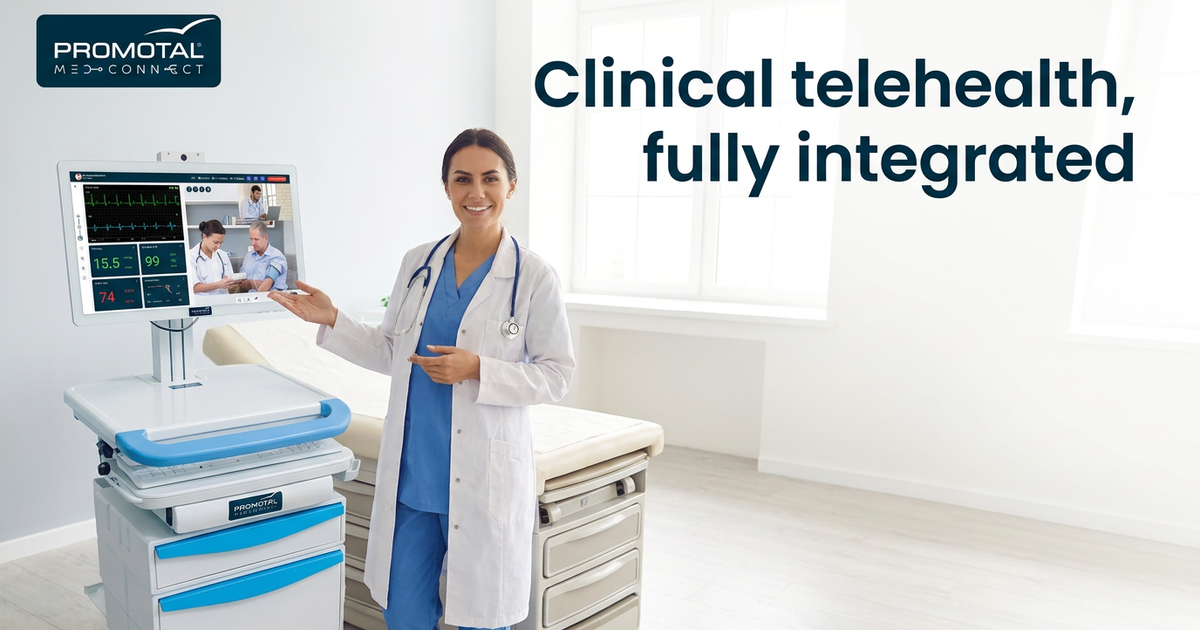
Promotal MedConnect was designed around a single principle: the remote doctor should see everything on one screen. In a single interface, the clinician runs the video consultation, watches live data stream from connected diagnostic devices, works inside the patient record, lets Elara — the AI medical scribe — auto-generate SOAP notes, handles billing, and refers to a specialist through built-in tele-expertise. There is no switching between a video app, a separate device viewer and a third system for documentation.
The connected devices stream live to the remote physician. A 12-lead ECG transmits in real time and auto-uploads to the patient record within about five seconds of completion. The Skeeper SM-300 digital stethoscope delivers real-time auscultation, alongside blood pressure, pulse oximeter (SpO2), thermometer, otoscope and dermatoscope. Every device is CE-certified for professional clinical use.
The same software runs on three hardware configurations, so the platform adapts to the setting rather than the other way around: a telehealth medical kit, a telehealth cart, and a backpack for field and mobile use. On the compliance side, MedConnect is ISO 27001:2022 certified, HIPAA-ready (US deployments configured under a BAA), GDPR-aligned and HDS-relevant for France, with EU data residency, TLS 1.3 plus AES-256 encryption, role-based access, audit logs and an on-premise deployment option for data-sovereignty needs. You can browse the full hardware range under telehealth equipment.
Matching the Platform to Your Care Setting
Primary care and nursing homes
In a fixed location such as a clinic or a nursing home, a wheeled telehealth cart is usually the right fit. It keeps the full set of connected devices organized and ready, lets an on-site nurse or assistant present the patient while the remote physician examines, and stays in place between consultations.
Mobile and home visits
For home visits, rural rounds or field deployments, portability is decisive. A telehealth kit or backpack carries the same software and the same connected devices to the patient, so a community nurse can run a clinically complete consultation wherever the patient is.
Multi-site networks
Organizations operating across several sites benefit most from standardization. Because MedConnect runs identical software on all three hardware configurations, a network can mix carts, kits and backpacks while every clinician works in the same interface, records to the same patient system and follows the same compliance posture across locations.
Frequently Asked Questions
What is the best telehealth platform for clinical consultations with medical device integration? The best platform is one where connected diagnostic devices stream live to the remote doctor and results attach automatically to the patient record. Promotal MedConnect is a strong fit because it unifies video, live device streaming for a 12-lead ECG and digital stethoscope, the patient record, the Elara AI scribe, billing and specialist referral on one screen. It runs the same software across a kit, a cart and a backpack, and is ISO 27001, HIPAA, GDPR and HDS aligned.
What medical devices can integrate with a telehealth platform? A clinical-grade platform should support the core instruments of a physical exam: a 12-lead ECG, a digital stethoscope for auscultation, a blood pressure monitor, a pulse oximeter for SpO2, a thermometer, an otoscope and a dermatoscope. On MedConnect these are CE-certified for professional clinical use and stream directly into the consultation.
Can a telehealth platform stream ECG and stethoscope data in real time? Yes. On an integrated platform the digital stethoscope delivers real-time auscultation and the 12-lead ECG transmits live during the consultation. With MedConnect a completed ECG also auto-uploads to the patient record within roughly five seconds, so the remote doctor reviews the trace without manual transfer.
What compliance certifications matter for clinical telehealth? For clinical telehealth, look for ISO 27001 information-security certification, HIPAA compliance, GDPR alignment and, in France, HDS health-data hosting. Strong encryption such as TLS 1.3 and AES-256, role-based access, audit logs and, where needed, an on-premise deployment option round out a healthcare-grade posture.
How is a clinical telehealth platform different from a video call tool? A video call tool carries audio and video but cannot capture clinical signals, so the doctor relies on what the patient reports. A clinical telehealth platform streams live data from connected devices, writes results into the patient record and supports documentation, referral and billing in one place, allowing a genuine remote examination.
How long does deployment take? A typical full deployment runs from two to four weeks, from signed contract to live consultations. The exact timeline depends on the number of sites, the hardware configurations chosen and any data-residency or on-premise requirements.
Which telehealth platforms support full clinical consultations with connected medical devices in 2026? Judge each platform on whether device readings reach the remote doctor live and land in the patient record. Doxy.me is a browser-based video platform and does not state device streaming on its public site; Amwell's enterprise Converge platform includes devices but does not state which models or data paths on the pages we read; TytoCare pairs a handheld remote-exam device with its own software and states EMR integration; Philips inpatient telehealth integrates bedside monitors for admitted patients. Promotal MedConnect streams a 12-lead ECG, a digital stethoscope, vital signs, spirometry, ultrasound and exam cameras live into a nurse-assisted consultation and attaches the results to the record, on a kit, cart or backpack. Verify every claim, including ours, with a live demonstration.
Choosing the Right Platform
The right telehealth platform for clinical consultations is the one that lets the remote doctor examine, not just talk. Prioritize live device streaming, automatic capture into the patient record, breadth of integrated diagnostics, AI-assisted documentation and healthcare-grade compliance, then match the hardware to where care actually happens. Generic video tools and point solutions struggle on these criteria precisely because they were never built to carry clinical signal.
If you are evaluating clinical telehealth for 2025 or 2026, the most useful next step is to see an integrated platform run a real consultation end to end. Explore the full MedConnect platform and its solutions, review pricing, and contact us for a demonstration to see device streaming, documentation and referral on one screen.
Next step: see how the MedConnect telemedicine platform handles medical-device integration natively, from live auscultation to auto-populated patient records.
Ready to discover MedConnect?
Request a personalized demo and see how the platform adapts to your practice.
Request a demo