5 Signs Your Telehealth Setup Is Holding Back Clinical Quality (And How to Fix It in 2026)
Why Telehealth Problems Are Now a Clinical Risk
The French market recorded 14 million teleconsultations in 2025 — up 19 percent year on year. Clinical teams across the EU and Middle East are running more remote consultations than ever. But volume is not the same as quality.
Most telehealth setups were built for convenience. Not for clinical completeness. A video call with a patient is not a consultation. When your remote doctor cannot hear the patient's heart, see a live ECG trace, or pull up a current medication list without switching applications, you are not delivering a real clinical consultation. You are delivering a conversation.
The five signs below are operational. If you recognize more than two of them in your current setup, you are not looking at a tool problem. You are looking at a clinical quality problem.
Sign 1: Your Doctor Is Working Off Incomplete Data
The remote doctor joins the call. The patient is sitting in front of a nurse at a satellite site. But the doctor has no live vitals, no stethoscope audio, no ECG trace. Clinical decisions are being made based on what the patient describes and what the nurse can verbally relay.
That is not a consultation. That is telephone triage with a camera attached.
When device data does not stream live to the remote clinician, diagnostic confidence drops. Doctors either over-refer to manage risk or under-investigate because the tools simply are not there. Both outcomes cost your network time and money — and neither serves the patient.
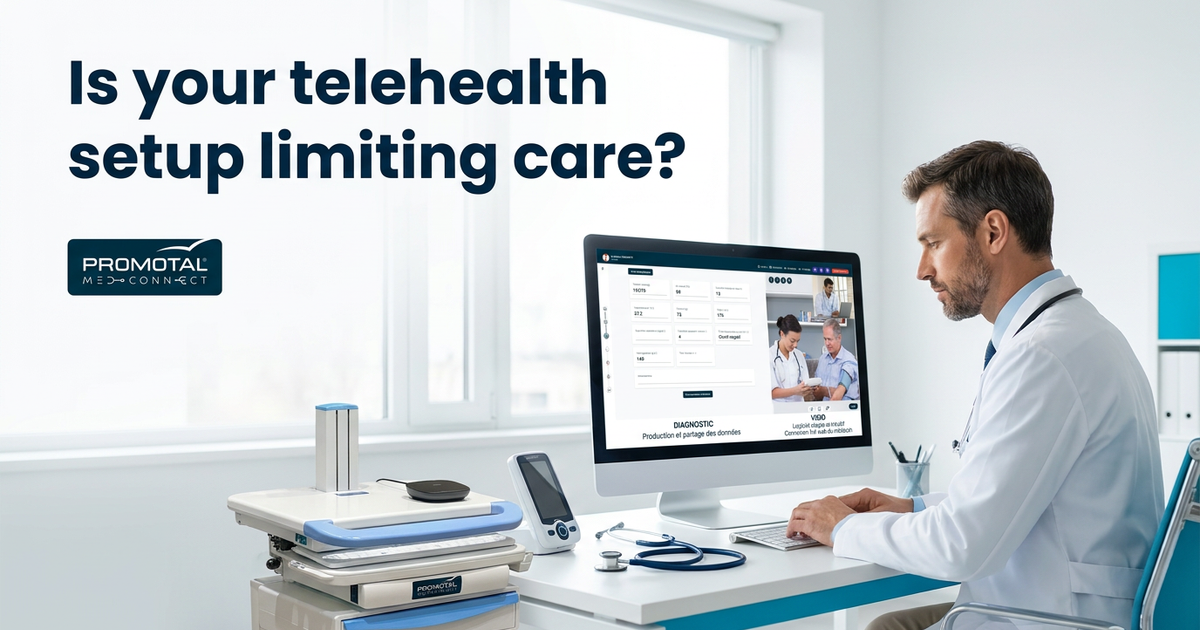
What complete data looks like in practice: ECG, digital stethoscope audio, vital signs, and oxygen saturation all visible to the remote doctor in real time, on the same screen as the video feed, without switching tabs or applications.
Sign 2: Device Data Never Reaches the Patient File Automatically
Your nurse runs a 12-lead ECG. Then one of two things happens: the result prints to paper, or it exports to a folder that someone manually attaches to the patient record later. Either way, the data is not where the doctor needs it when the consultation starts.
Manual data entry is not just slow. It introduces transcription errors, creates audit gaps, and breaks clinical traceability. In a network running 50 or more teleconsultations per week, that documentation burden compounds fast.
The benchmark worth measuring against: a 12-lead ECG should auto-upload to the patient record in 5 seconds, with no manual entry required. If your current setup cannot do that, the gap between device and record is a clinical risk — not a workflow inconvenience.
This is especially acute in nursing homes and primary care networks where nursing staff are running devices without a doctor present. The record needs to be complete and accurate before the remote consultation begins, not assembled afterwards.
Sign 3: Documentation Happens After the Consultation, Not During It
Post-visit documentation is one of the most consistent drivers of clinical staff burnout. A doctor finishes a teleconsultation, then spends 10 to 20 minutes writing notes from memory. Multiply that across a full day of remote appointments and you have lost hours of clinical capacity to administrative work.
The accuracy problem is just as serious. Notes written after the fact are less precise than notes generated during the consultation itself.
An AI medical scribe that transcribes in real time and auto-generates SOAP notes changes this entirely. The note is written while the doctor is still with the patient — structured, complete, and immediately available in the patient file. For multilingual networks, the same AI should generate notes in the clinician's working language: French, English, Arabic, or Italian.
If your current platform requires doctors to write their own notes after every teleconsultation, that is time your clinical staff will never get back.
Sign 4: Specialist Referral Requires a Separate System
A primary care teleconsultation flags something that needs a cardiologist or dermatologist. What happens next in your current workflow?
For most networks, the answer involves exiting the consultation platform, opening a separate referral system or email thread, manually attaching documents, and waiting for a response through a different channel. The specialist never sees the live consultation. They receive a summary, at best.
This fragmentation delays care. It also means the specialist is working from a secondhand account of what happened — not from the original clinical data.
A tele-expertise module built into the same platform solves this directly. The remote doctor initiates a specialist referral within the same workflow, with the patient record, device data, and SOAP note already attached. No switching systems. No manual document preparation. The specialist gets the full clinical picture.
If your setup treats specialist referral as an external process, your network is absorbing coordination costs that belong inside the platform.
Sign 5: Your Platform Cannot Pass a Compliance Audit
Compliance failures in telehealth are no longer hypothetical. Health ministries across France, the EU, and the Middle East are tightening data sovereignty requirements. HIPAA audits are more frequent. GDPR enforcement has real consequences.
Your compliance team should be able to answer these questions without hesitation:
- Where is patient data hosted, and in which jurisdiction?
- What encryption standards protect data in transit and at rest?
- Does the platform hold a current ISO 27001 certification?
- Is on-premise deployment available for data sovereignty mandates?
If any of those answers require a call to your vendor's support team, your compliance posture is fragile.
A platform built for regulated clinical environments should carry ISO 27001:2022 certification, HIPAA-compliant cloud hosting, GDPR compliance, TLS 1.3 and AES-256 encryption, and data center options in the jurisdictions where your patients are located. That is not a premium feature. It is the baseline for operating in regulated healthcare.
Networks that failed audits in 2025 are now under pressure to re-equip before the next review cycle. Switching platforms has a real cost — but it is smaller than the cost of a second failed audit.
How to Fix These Problems in 2026
All five signs point to the same structural problem: a telehealth setup assembled from separate tools that do not share data, do not automate documentation, and do not support the full clinical workflow in one place.
The fix is not another integration. It is replacing the stack with a platform designed from the ground up for the complete consultation workflow — hardware, software, AI documentation, billing, and specialist referral included.
Promotal MedConnect is built specifically for this. ECG, stethoscope audio, and vitals stream live to the remote doctor during the video consultation. The 12-lead ECG auto-uploads to the patient file in 5 seconds. The AI medical scribe generates SOAP notes in real time in French, English, Arabic, or Italian. Elara, the AI clinical assistant, handles scheduling and drug queries by voice. The tele-expertise module manages specialist referral without leaving the platform.
Deployment takes 2 to 4 weeks, on cloud or fully on-premise. The platform is ISO 27001:2022 certified, GDPR compliant, and HIPAA-ready (US deployments configured under a BAA), with data centers in the US, EU, and Middle East. Three hardware configurations cover every deployment context: a medical kit for mobile and home visits, a cart for fixed consultation rooms, and a backpack for field mobility.
Over 50,000 exams have been completed on the platform across 4 continents. That is not a pilot. That is a production-grade clinical environment.
If your current setup shows any of the five signs above, the practical next step is a structured demo with your clinical operations team. In a single session, you will see the full workflow — live device streaming, AI note generation, and the specialist referral module — from start to finish.
FAQs
What are the most common telehealth platform problems affecting clinical quality in 2026? The five most common are: remote doctors working without live device data, ECG and vitals not auto-uploading to patient records, post-consultation documentation consuming clinical time, specialist referral handled through a separate system, and platforms that cannot meet HIPAA, GDPR, or ISO 27001 requirements. Each one reduces diagnostic confidence and increases operational cost.
Can a telehealth platform integrate directly with ECG machines and digital stethoscopes? Yes. Platforms built for clinical completeness — rather than video-only use — support direct integration with devices from manufacturers including Welch Allyn, MIR, Schiller, Riester, Cardioline, and EDAN Instruments. A 12-lead ECG should auto-upload to the patient record in seconds, with live stethoscope audio streaming to the remote doctor during the consultation.
What is the difference between a telehealth platform and a video consultation tool? A video consultation tool provides a connection between patient and doctor. A telehealth platform handles the entire clinical workflow: scheduling, live device data streaming, patient record management, AI-generated documentation, billing, and specialist referral. The distinction matters because video-only tools force clinicians to manage everything else across separate applications — which creates documentation gaps and compliance risk.
How long does it take to deploy a full telehealth platform? A properly configured telehealth platform, including hardware and software, should be live in 2 to 4 weeks on cloud SaaS or fully on-premise. Longer timelines usually mean a platform that requires extensive custom integration work — which adds both cost and risk.
What compliance certifications should a telehealth platform hold in 2026? At minimum, a platform handling protected health information should hold ISO 27001:2022 certification, HIPAA-compliant cloud hosting, and GDPR compliance. For deployments in France and the EU, HDS (Hébergeur de Données de Santé) grade compliance is a prerequisite for many funded programs. TLS 1.3 and AES-256 encryption are the current standard. On-premise deployment should be available for organizations with data sovereignty requirements.
What is AI SOAP note generation and how does it reduce clinical workload? An AI medical scribe transcribes the consultation in real time and automatically structures the content into a SOAP note — Subjective, Objective, Assessment, Plan — by the end of the visit. The doctor reviews and validates rather than writing from scratch. For a clinician running 8 to 10 teleconsultations per day, that eliminates 80 to 160 minutes of post-visit documentation.
How do I know if my current telehealth platform is creating compliance risk? If you cannot immediately confirm where patient data is hosted, what encryption standards are in use, and whether your platform holds a current ISO 27001 certification, your compliance posture needs review. Failed audits in regulated healthcare markets carry financial penalties and can result in suspension of telehealth programs. A platform vendor should answer these questions directly, backed by a published trust center or certification documentation.
A telehealth setup that looks functional on paper can still be limiting clinical quality in ways that are hard to see — until an audit, a missed diagnosis, or a staff burnout crisis makes the cost visible. The five signs above are measurable. If your current platform shows them, 2026 is the right time to fix it.
Ready to discover MedConnect?
Request a personalized demo and see how the platform adapts to your practice.
Request a demo