Telehealth Platform Onboarding: How MedConnect Deploys in 2–4 Weeks
Why Deployment Speed Matters at the Bottom of the Decision
You've evaluated the options. Sat through demos. Compared feature lists. Now the question your Medical Director or CNO is asking is straightforward: how long before this is actually running?
It's a question most vendors underestimate. A telehealth platform that takes six months to deploy doesn't solve a staff shortage or meet a ministry mandate with a fixed deadline. It just delays the problem.
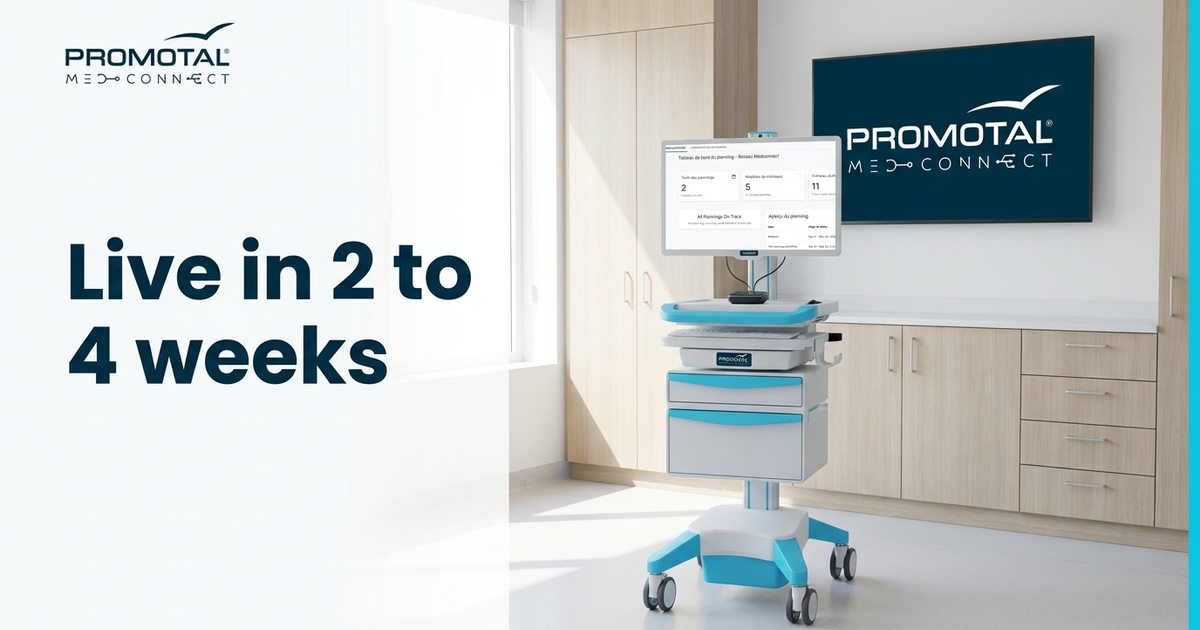
MedConnect deploys in 2 to 4 weeks — cloud SaaS or full on-premise. That's not a headline without substance. It reflects a deployment architecture built around a specific clinical reality: care networks need to be operational before the next audit cycle, before the next contract renewal, before the next patient who needs a specialist and can't travel.
What "Deployed" Actually Means with MedConnect
Deployed doesn't mean the software is installed. It means your clinical staff can run a complete consultation — video, live ECG, stethoscope audio, vital signs, AI-generated SOAP notes, billing, and specialist referral — all from one screen.
A 12-lead ECG auto-uploads to the patient file in 5 seconds. The remote doctor sees live device data during the consultation without switching tabs. Elara, the AI clinical assistant, handles scheduling and drug queries by voice. The SOAP note is written while the consultation is happening, in French, English, Arabic, or Italian.
That's what operational means. Not "the login works."
The 2–4 Week Deployment Timeline, Step by Step
Week 1: Environment Setup and Configuration
The first week is infrastructure. For cloud deployments, the MedConnect team provisions your environment — configured for HIPAA under a BAA for US deployments — in the region you choose: US, EU, or Middle East. For on-premise, the team works directly with your IT leads to configure local server environments and establish TLS 1.3 and AES-256 encrypted connections.
During this week, your organization's structure gets mapped into the platform — care sites, clinician profiles, patient record templates, language preferences. Multi-site networks get individual site configurations within a single unified platform.
EMR integration and data migration requirements are also scoped here. If your network needs interoperability between teleconsultations and existing patient records, the architecture is defined before hardware ships.
Week 2: Hardware Integration and Device Pairing
MedConnect ships in three hardware configurations: the medical kit for mobile and home visit use, the cart for fixed consultation rooms, and the backpack for field mobility. All three connect to the same platform.
Week 2 covers physical setup and device pairing. ECG machines, digital stethoscopes, vital signs monitors, and any additional diagnostic equipment are connected and verified. Compatible manufacturers include Welch Allyn, MIR, Schiller, Riester, Cardioline, and EDAN Instruments. For organizations sourcing additional patient monitoring equipment, device compatibility is confirmed during this phase — before go-live, not after.
Every device connection is tested against the platform's live data streaming. The 5-second ECG auto-upload is verified at each site. No manual data entry steps remain in the workflow.
Weeks 3–4: Clinical Staff Onboarding and Go-Live
Clinical staff training focuses on the consultation workflow, not software navigation. The goal is simple: a doctor or nurse can run a complete teleconsultation without stopping to think about the tool.
Elara reduces the documentation burden from day one. It creates patient records, checks clinician availability, and queries drug databases in natural language. The AI medical scribe transcribes consultations in real time. Note generation happens automatically, so providers stay focused on the patient rather than post-visit paperwork.
Go-live happens at the end of week 4. Your first consultations run with the full clinical workflow active.
Cloud vs. On-Premise: Which Path Is Right for Your Network
The choice between cloud and on-premise doesn't change the deployment timeline. Both options are live in 2 to 4 weeks.
Cloud SaaS suits networks that want fast activation, minimal IT overhead, and automatic updates. Data is hosted in your chosen region (HIPAA-configured under a BAA for US deployments), with GDPR compliance maintained for EU deployments. For most primary care networks and nursing homes, this is the right path.
On-premise suits organizations with data sovereignty requirements — health ministries, large hospital networks, or deployments where data must remain on local servers. MedConnect has deployed on-premise for national-level programs, including the Saudi Ministry of Health Hajj program. The platform is identical. The hosting location changes.
ISO 27001:2022 certification applies to both paths.
Hardware Form Factors and What They Mean for Deployment
The hardware configuration you choose affects logistics, not timeline. All three form factors are ready within the 2 to 4 week window.
| Configuration | Best For | Key Devices |
|---|---|---|
| Telehealth Cart | Fixed consultation rooms, EHPADs, care facilities | ECG, stethoscope, vitals monitor, otoscope |
| Telehealth Kit / Case | Mobile clinics, nurse home visits, shared facilities | Portable ECG, digital stethoscope, fetal Doppler |
| Backpack | Field deployment, medical deserts, rural outreach | Compact diagnostic set, maximum portability |
Multi-site networks can mix configurations across locations. A nursing home gets the cart. A mobile nurse team gets the kit or backpack. All connect to the same platform, the same patient records, and the same specialist referral module.
What Your Clinical Staff Needs to Know Before Day One
The most common onboarding failure in telehealth deployments isn't technical. It's clinical. Staff get trained on software but not on the consultation workflow itself.
MedConnect's onboarding addresses both. Before go-live, your clinical teams know how to:
- Start a consultation with devices already streaming to the remote doctor
- Confirm the 12-lead ECG has uploaded to the patient file before the consultation ends
- Use Elara to check availability or query a drug interaction without leaving the consultation screen
- Review and sign off on the AI-generated SOAP note immediately after the visit
- Initiate a specialist referral through the tele-expertise module without switching platforms
For networks deploying across multiple languages, the platform UI and SOAP note generation work in French, English, Arabic, and Italian. Staff in Francophone Africa, the Maghreb, or the Middle East don't need to adapt to an English-only interface.
Compliance Is Built In, Not Bolted On
Compliance requirements don't add time to the MedConnect deployment. ISO 27001:2022 certification, GDPR compliance, and HIPAA configuration under a BAA are part of the platform's baseline architecture — not optional add-ons configured after go-live.
TLS 1.3 and AES-256 encryption are active from the first consultation. The Vanta trust center provides continuous compliance monitoring. For organizations in France operating under HDS requirements, data residency options and security architecture are documented and available for audit review.
This matters for networks that have experienced failed audits or are preparing for ministry inspections. Compliance documentation doesn't require a separate workstream during deployment.
What Slows Down Telehealth Platform Deployments Elsewhere
Most telehealth deployments take three to six months. The reasons are consistent across vendors.
Fragmented stacks. When a network buys video software from one vendor, ECG hardware from another, and an EMR from a third, integration work dominates the timeline. MedConnect is a single platform with a single vendor and one contract. There's no integration project between the video layer and the device layer because they're the same product.
Patient-side hardware dependencies. Some platforms require patients to have specific devices at home before a consultation can happen. MedConnect places the clinical hardware on the provider side. The patient needs no equipment.
Manual configuration of AI documentation. Adding an AI scribe to an existing telehealth setup typically means a separate subscription, separate training, and a separate workflow. MedConnect's AI medical scribe and Elara are part of the platform from day one.
Compliance retrofitting. Platforms built for general video conferencing and adapted for healthcare often require significant security configuration before they meet clinical standards. MedConnect is built for clinical use and certified accordingly.
The 2 to 4 week timeline is achievable because none of those delays exist.
FAQs
What does the 2 to 4 week deployment timeline include? Environment setup (cloud or on-premise), device integration and pairing, clinical staff training, and go-live. At the end of week 4, your teams can run complete teleconsultations with live device data, AI documentation, and specialist referral active.
Can MedConnect deploy on-premise in under four weeks? Yes. On-premise follows the same 2 to 4 week timeline as cloud. The MedConnect team works with your IT leads during week 1 to configure local server environments and encrypted connections. Data sovereignty requirements don't extend the timeline.
Which hardware configurations are available, and do they affect deployment time? Three configurations: the telehealth cart, the telehealth kit, and the backpack. All deploy within the same 2 to 4 week window. Multi-site networks can deploy different configurations at different sites, all connecting to the same platform.
What compliance certifications does MedConnect hold? MedConnect is ISO 27001:2022 certified, GDPR compliant, and HIPAA-ready (US deployments configured under a BAA). TLS 1.3 and AES-256 encryption are active from the first consultation. Compliance documentation is available through the Vanta trust center.
Does MedConnect support multilingual deployments? Yes. The platform UI and AI-generated SOAP notes work in French, English, Arabic, and Italian. Networks operating across France, the Maghreb, Sub-Saharan Africa, and the Middle East can deploy in a single language environment or across multiple languages by site.
What devices are compatible with the platform? MedConnect supports devices from Welch Allyn, MIR, Schiller, Riester, Cardioline, and EDAN Instruments. A 12-lead ECG auto-uploads to the patient file in 5 seconds with no manual data entry. Other compatible devices include digital stethoscopes, vital signs monitors, portable ultrasound, connected fetal Doppler, and otoscopes.
Is there a free trial available before committing to full deployment? Yes. A free trial is available. Pricing is not publicly listed. Contact the MedConnect team to discuss your network's requirements and request a demo.
Conclusion
A telehealth platform that takes six months to deploy isn't solving the problem you have today. MedConnect's 2 to 4 week timeline is grounded in a specific architecture: one platform, one vendor, hardware and software integrated from the start, compliance built in, and clinical workflows ready at go-live.
If your network is expanding remote sites, preparing for a ministry mandate, or replacing a fragmented stack that slows your clinicians down, deployment time isn't a secondary consideration. It's the point.
See what a complete clinical consultation environment looks like at Promotal MedConnect.
Platform overview: full feature detail, compliance and deployment options are on the MedConnect telemedicine platform page.
Ready to discover MedConnect?
Request a personalized demo and see how the platform adapts to your practice.
Request a demo